What is a Holistic Approach to Health? A Guide to Whole-System Wellbeing
- alastair208
- Jun 13
- 12 min read
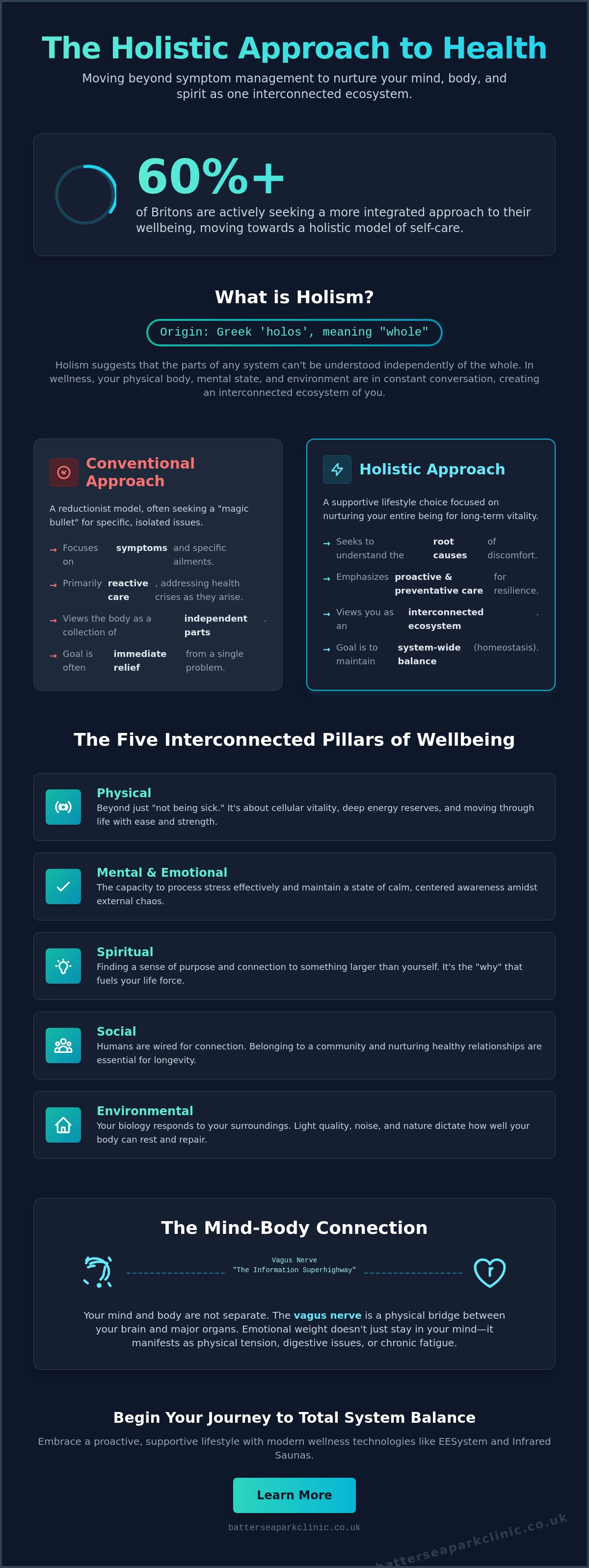
What if your chronic fatigue isn't a medical mystery, but a whisper from a system that's simply out of balance? Many people living in fast-paced cities feel a sense of exhaustion that standard medical appointments don't quite capture. You might have normal blood test results but still lack the energy to enjoy your daily life. If you've ever felt like your care is rushed or focused only on a single symptom, you aren't alone. As of early 2026, over 60% of Britons are actively seeking a more integrated way to look after their wellbeing. Understanding what is a holistic approach to health is the first step toward finding a more supportive path to restoration.
It's natural to want a deeper connection to your own vitality rather than just a quick fix. This guide promises to help you move beyond symptom management by nurturing your mind, body, and spirit as one interconnected ecosystem. We'll explore how different parts of your life affect your physical health and provide a clear framework for self-care. You'll discover how to shift your focus toward equilibrium and create a calm sanctuary for long-term rejuvenation.
Key Takeaways
Understand what is a holistic approach to health by exploring the Greek root 'holos' and how it shifts focus from fixing parts to supporting your entire system.
Discover the five interconnected pillars of wellbeing that help you move beyond simply not being sick toward a state of thriving cellular vitality.
Learn how to audit your daily environment to minimise toxins and maximise restorative inputs like natural light and deep relaxation.
Identify the benefits of shifting from a reactive mindset to a restorative one, building a buffer against the stresses of a fast-paced lifestyle.
Explore how modern wellness technologies, such as the EESystem and Infrared Saunas, provide an immersive environment for total system balance.
Table of Contents
Defining the Holistic Approach: Beyond the Sum of Parts
To truly understand what is a holistic approach to health, we must first look at the language itself. The term originates from the Greek word holos, meaning whole. This is the foundation of Holism, a philosophy suggesting that the parts of any system can't exist or be understood independently of the whole. In a wellness context, this means your physical body, your mental state, and your surrounding environment are all in constant conversation.
Traditional western medicine often relies on a reductionist model. This approach is excellent for isolated issues, such as setting a broken bone or treating an acute infection. However, a holistic approach views you as an interconnected ecosystem. It recognizes the profound relatedness between your systems; for example, how your gut health directly influences your mental clarity and emotional resilience. It's a supportive lifestyle choice focused on nurturing your entire being. This isn't a substitute for professional medical advice. Instead, it's a complementary path that helps you maintain your internal equilibrium.
The Interconnected Ecosystem of You
Consider how a simple symptom like a headache is often treated. A narrow view focuses only on the pain in the skull. A holistic perspective looks deeper by examining several factors:
Physical strain from poor posture or long hours at a desk.
Dehydration or nutritional gaps that affect cellular function.
The mental weight and nervous system strain of a high-pressure city environment.
Homeostasis is your body's natural drive toward internal balance. By recognizing these connections, you can form a proactive partnership with your body’s intelligence. You begin to address the root causes of your discomfort rather than just masking the symptoms. This shift in perspective allows you to support your system before it reaches a point of crisis.
Holism vs. Conventional Medicine
The difference between these two paths can be seen as the "Magic Bullet" versus "System Support." Conventional medicine often looks for a single intervention to fix a specific problem. This is vital for reactive care during a health crisis. Proactive holistic care, on the other hand, focuses on long-term maintenance. It provides the tools your system needs to stay resilient against the inevitable stresses of modern life.
While reactive care handles the immediate fire, proactive care ensures the environment is too healthy to catch fire in the first place. This philosophy empowers you to take the lead in your own health journey. Taking this path allows you to stop being a passive observer of your symptoms. When you embrace what is a holistic approach to health, you become an active guardian of your own enduring vitality and life force.
The Five Interconnected Pillars of Holistic Wellbeing
Understanding what is a holistic approach to health requires looking at the multidimensional aspects of wellness that make up your daily experience. We often think of health as a single metric. In reality, it's a tapestry of five core pillars that must work in harmony to create true vitality.
Physical: This goes beyond "not being sick." It's about cellular vitality and the energy to move through your day with ease and strength.
Mental & Emotional: This involves the capacity to process stress and maintain a state of calm, centered awareness even when your external world feels chaotic.
Spiritual: This doesn't necessarily mean religion. It’s about finding a sense of purpose and a connection to something larger than your immediate worries. It's the "why" that fuels your life force.
Social: Humans are biologically wired for connection. Belonging to a community and nurturing healthy relationships are essential factors for longevity. Isolation can be as taxing on the body as physical illness.
Environmental: Your biology responds to your surroundings. Factors like light quality, noise levels, and the presence of nature dictate how well your body can rest and repair.
Physical and Mental: The Feedback Loop
Your mind and body aren't separate rooms; they're connected by a busy corridor called the vagus nerve. This nerve acts as a physical bridge between your brain and your major organs. When you carry emotional weight, it doesn't stay in your mind. It often manifests as physical tension, digestive issues, or chronic fatigue. To address this, many people use Numa breathwork to bridge the gap. This practice helps release stored somatic tension, allowing the body to return to a state of equilibrium. By calming the nervous system, you create the internal space needed for physical healing to occur naturally.
The Environmental Pillar: Living in the Modern World
Living in a city like London introduces invisible factors that can disrupt your internal balance. Constant exposure to EMFs, blue light from screens, and noise pollution can keep your nervous system in a state of high alert. This is why sensory deprivation and nature therapy are so effective for urban dwellers. By creating a sacred space at home for reflection or visiting a wellness sanctuary, you give your biology the quiet it needs to restore itself. When you address these environmental stressors, you strengthen the foundation of your entire health system. This proactive care ensures that your surroundings support your journey toward lasting vitality rather than draining your energy reserves.
Shifting from Reaction to Restoration: The Benefits of Holism
Moving from a reactive mindset to a restorative one is perhaps the most significant benefit of this philosophy. In a traditional setting, we often wait until something feels "broken" before seeking help. However, understanding what is a holistic approach to health allows you to transition from being a passive patient to an active participant in your own vitality. This shift creates a sense of personal agency, where you learn to interpret your body's early signals before they escalate into chronic issues. Instead of relying on the temporary lift of caffeine or stimulants, you learn to cultivate a steady stream of life force that persists throughout your day.
By building this internal awareness, you create a buffer against the inevitable pressures of city life. This isn't just about feeling better in the moment; it's about developing sustainable vitality. While many people associate holistic medicine with specific therapies, its primary gift is the cultivation of deep, systemic resilience that supports every aspect of your existence.
Building Biological Resilience
The concept of allostatic load describes the cumulative wear and tear on the body caused by chronic stress. When your system is constantly flooded with cortisol, your ability to recover diminishes. Holistic practices are designed to lower these stress markers and support the parasympathetic nervous system, which is responsible for rest and digestion. True restoration is an active process of renewal, not simply the absence of work or effort. By intentionally engaging in restorative practices, you lower your biological "debt" and allow your cells to function at their highest potential.
Longevity and the Preventative Mindset
Waiting for a physical symptom to appear is often a late-stage approach to health. Systemic imbalances usually begin at a cellular or energetic level long before they manifest as a diagnosable condition. A holistic perspective prioritizes the cellular environment, ensuring your body has the stability it needs to repair itself daily. Small, consistent shifts in your lifestyle today prevent the accumulation of imbalances that lead to future health challenges. This preventative mindset is the cornerstone of longevity, focusing on the quality of your years as much as their quantity. When you nourish the whole system, you aren't just avoiding illness; you're actively inviting a state of thriving equilibrium.
Practical Steps: Adopting a Holistic Lifestyle in London
Living in the heart of London requires more than just endurance; it demands a conscious strategy for equilibrium. When you consider what is a holistic approach to health in a practical sense, it begins with an audit of your immediate environment. Our city surroundings often include high levels of noise, persistent artificial light, and environmental toxins that can slowly overwhelm our biological systems. By intentionally maximizing restorative inputs, such as seeking out natural light during the morning hours and filtering your drinking water, you begin to lower the invisible toxic load on your cells. This proactive management creates a cleaner internal landscape where your body's natural healing processes can flourish.
Nourishment also plays a vital role in this transition. Moving beyond a simple focus on calories allows you to prioritize nutrient density and deep hydration. This cellular-level support ensures your body has the building blocks it needs for daily repair and maintenance. Additionally, scheduling "restorative windows" is essential for long-term vitality. These are dedicated times for non-doing where you step away from productivity and digital demands to allow your nervous system to return to a state of calm. It's about creating a sustainable rhythm that prevents the crash and burn cycle common in urban life.
The City Dweller’s Survival Guide
Managing the Battersea pace often feels like a full-time job. To stay grounded, use the borough's green spaces like Battersea Park for regular mental resets. Even twenty minutes of walking among trees can significantly lower stress markers and clear mental fog. To protect your circadian rhythm, establish a digital detox ritual at least one hour before bed. Turning off screens and dimming lights helps your brain transition into a state of deep, restorative sleep, which is the foundation of all holistic wellbeing.
Modern Tools for Holistic Support
In a high-tech world, we sometimes need technology to help us return to a natural state of rest. Modern wellness tools act as a bridge, supporting ancient biological needs that the city environment often neglects or disrupts. Tech-assisted rest allows you to achieve deep states of relaxation that might be difficult to reach through willpower alone in a noisy borough. For instance, infrared light therapy can mimic the healing wavelengths of natural sunlight, supporting cellular energy and circulation. For those experiencing deep urban depletion or post-travel fatigue, IV drips provide targeted support by delivering essential nutrients directly to the system. These tools aren't meant to replace nature, but rather to supplement it within a modern lifestyle.
Finding a local community of like-minded individuals can also strengthen your commitment to whole-system wellbeing. Shared experiences in wellness hubs help normalize these practices as part of a healthy routine. If you're ready to start your journey, you can connect with our team to discover how these tools can support your personal path to vitality.
Your Holistic Sanctuary: Battersea Park Clinic
At Battersea Park Clinic, we believe that understanding what is a holistic approach to health is only the beginning. The true transformation happens when you step into an environment designed to support your body's natural state of equilibrium. We've created a non-clinical oasis in the heart of London; it's a serene space where you can disconnect from the city's noise and reconnect with your internal life force. Our ethos is built on the principle of nurturing the whole person, offering a sanctuary for those seeking deep restoration and sustainable vitality.
Our clinic provides a supportive bridge between modern wellness technology and your body's ancient biological needs. We don't just offer sessions; we provide a space for you to become an active participant in your own wellbeing. With our expert guidance, you can create a bespoke wellness routine that fits seamlessly into your daily life. This personalized path ensures that every experience within our walls contributes to your long-term stability and rejuvenation.
The Power of the EESystem
The centerpiece of our sanctuary is the 24-unit Energy Enhancement System (EESystem). This advanced technology creates an immersive environment where scalar waves and bio-photonics support the body at a foundational level. These fields help your cells return to an optimal state of charge, facilitating a deep sense of internal balance. You can learn more by reading our full guide on the Energy Enhancement System. In our centre, the simple act of doing nothing becomes a powerful form of self-care. As you rest in our comfortable lounge, your system is free to focus entirely on its own restoration without the interference of external city stressors.
A Multi-Sensory Path to Vitality
To further support your journey, we offer a range of complementary therapies that work together for synergistic effects. Combining Hyperbaric Oxygen Therapy with Infrared Saunas or Red Light Therapy provides a multi-sensory approach to system maintenance. While HBOT supports oxygenation at a cellular level, light therapies mimic the restorative frequencies of the sun. These experiences are housed within a calm and reassuring environment, ensuring you feel safe and nurtured throughout your visit. When you embrace what is a holistic approach to health through these integrated tools, you build a resilient foundation for a thriving life. We invite you to visit our London clinic to start your holistic journey today and discover a new level of serene confidence in your wellbeing.
Embrace Your Path to Lasting Vitality
You've explored how treating your body as an interconnected ecosystem allows you to move beyond simply managing symptoms. By balancing the physical, mental, and environmental pillars of your life, you build a resilient foundation that city living cannot easily shake. Understanding what is a holistic approach to health represents a transformative shift from reactive care to a lifestyle of proactive restoration. It's about nurturing your entire being to ensure your life force remains steady and strong through every season of life.
Battersea Park Clinic serves as your calm, nurturing oasis in the heart of Battersea. As London’s premier 24-unit Energy Enhancement System centre, we offer an expertly curated range of non-invasive wellbeing therapies designed to restore your internal equilibrium. You deserve to feel vibrant and centered in your daily life. Our team is here to guide you toward a state of enduring renewal within a safe and supportive environment. Book a restorative session at Battersea Park Clinic and begin your journey toward whole-system wellbeing today. We look forward to supporting your transition into a more balanced and vital way of living.
Frequently Asked Questions
What is the main difference between holistic and conventional medicine?
Conventional medicine is often reactive and focuses on treating isolated parts or symptoms, whereas a holistic approach is a proactive partnership that supports your entire system. It looks at how your environment, emotions, and physical state interact to influence your wellbeing. This perspective helps you build long-term resilience rather than just addressing a single issue in isolation.
Do I need to be ill to benefit from a holistic approach to health?
You don't need to be experiencing illness to benefit from these restorative practices. A holistic approach is primarily about moving from a state of being "not sick" to one of thriving vitality. By supporting your system when you feel well, you build a biological buffer against future stress. It’s a way to maintain your life force and ensure your body has the resources it needs to repair itself daily.
Can I use holistic therapies alongside my GP appointments?
Yes, holistic therapies are designed to be complementary to your standard medical care. They provide a supportive layer of wellness that works alongside the clinical advice of your GP. While your doctor handles medical needs, these practices focus on your daily lifestyle and internal equilibrium. It's always a good idea to maintain transparency with your medical professionals about the wellness routines you choose to adopt.
How long does it take to see results from a holistic lifestyle change?
The timeline for results varies depending on your individual state and the consistency of your habits. You might feel a sense of calm or improved mental clarity after a single session of tech-assisted rest. However, deeper systemic changes usually require a sustained commitment over several weeks or months. True restoration is a gradual process of returning your body to its natural state of balance.
Is holistic health expensive to maintain in a city like London?
Maintaining your wellbeing in London can be tailored to fit your personal resources. Many foundational habits, such as walking in local parks or establishing a digital detox ritual, are entirely free. Investing in specialized sessions at our clinic is a way to supplement these daily choices. Understanding what is a holistic approach to health helps you prioritize where to focus your energy for the best long-term results.
What are some simple holistic habits I can start today?
You can start today by introducing small, intentional shifts into your daily routine. Try spending fifteen minutes in natural sunlight each morning to support your circadian rhythm. Focus on deep, mindful breathing during your commute to calm your nervous system. These simple acts, combined with proper hydration, create a strong foundation for your journey toward whole-system wellbeing without requiring a major lifestyle overhaul.
How does the EESystem at Battersea Park Clinic support a holistic approach?
The EESystem supports this approach by creating an immersive environment that promotes total system balance. It doesn't target a specific symptom but instead provides scalar waves and bio-photonic energy to help your cells recharge. This helps your body return to a state of homeostasis, which is a core goal of what is a holistic approach to health. It gives your system the quiet space it needs to restore itself.
What role does diet play in a holistic health framework?
Diet provides the essential building blocks for your cellular health and energy levels. In a holistic framework, we view food as more than just calories; it's information that tells your body how to function. Prioritizing nutrient-dense, whole foods helps reduce internal inflammation and supports your mental clarity. When your cells are well-nourished, your entire system can maintain its equilibrium more effectively.


Comments