Near Infrared vs Far Infrared Sauna: Which is Best for Your Wellbeing?
Updated: Apr 11
What if the warmth you feel on your skin is actually the least significant part of your sauna experience? You've likely felt the frustration of scrolling through conflicting online advice while simply searching for a way to restore your natural balance. It’s common to feel overwhelmed by technical terms when your real goal is vitality and rest. Choosing between a near infrared vs far infrared sauna shouldn't feel like a physics exam, but the difference in how these wavelengths penetrate your body can change your entire wellbeing routine.
We're here to demystify the science, moving past the jargon to focus on what matters for your health. A 2021 study published in the journal Biology suggests that specific light frequencies can support cellular recovery, making your choice a vital part of a personalised self-care journey. In this article, you'll discover the distinct benefits of each wavelength to help you decide which therapy aligns with your intentions. We'll also show you how to access these modern technologies at our calm, supportive clinic in London.
Key Takeaways
Understand the core differences between infrared wavelengths to better support your body's natural rhythm and vitality.
Discover how Near Infrared light encourages cellular energy production, helping you feel more balanced and revitalised at a mitochondrial level.
Learn the benefits of Far Infrared for deep thermal penetration and vigorous sweating, essential for a thorough detoxification experience.
Evaluate near infrared vs far infrared sauna options by comparing heat intensity and penetration depth to find the perfect fit for your health journey.
See how we use SaunaSpace technology at our London clinic to provide a gentle, targeted approach to your personal wellbeing ritual.
Table of Contents The Science of Invisible Light: Understanding Infrared Wavelengths Near Infrared (NIR): The Power of Photobiomodulation Far Infrared (FIR): Deep Detoxification and Core Warming Near Infrared vs Far Infrared: A Comparative Framework Integrating Infrared into Your London Wellbeing Ritual
The Science of Invisible Light: Understanding Infrared Wavelengths
Infrared light is a naturally occurring form of energy that occupies the invisible part of the electromagnetic spectrum. While we cannot see these rays with the naked eye, we experience them as a gentle, soothing warmth. This spectrum is divided into three distinct bands based on their wavelength: Near (NIR), Mid (MIR), and Far (FIR). Near infrared operates at the shortest wavelength, typically between 0.7 and 1.4 microns, while Far infrared reaches much longer wavelengths up to 100 microns. Each band interacts with human tissue differently. Understanding the nuances of a near infrared vs far infrared sauna begins with how these wavelengths penetrate the body. Unlike traditional steam saunas that rely on heating the surrounding air to temperatures often exceeding 80°C, infrared technology uses radiant heat. This energy travels directly to your body without warming the air between you and the heater, creating a more breathable and comfortable environment for your wellbeing routine.
How Radiant Heat Works in the Body
The core of infrared's effectiveness lies in a process called photobiomodulation. This occurs when light photons are absorbed by the mitochondria, the powerhouses of your cells, to stimulate energy production and cellular repair. Because infrared energy operates at a frequency that matches the water molecules in our bodies, it triggers a deep cellular resonance. This allows the heat to penetrate up to 4 centimetres below the skin's surface. While a traditional sauna only warms the top layer of skin, radiant heat reaches deeper tissues to support natural detoxification and relaxation from within. This bypasses the need for stiflingly hot air, making it a more accessible option for those who find high humidity uncomfortable.
The Evolution of Infrared Sauna Technology
Sauna technology has advanced significantly since Dr John Harvey Kellogg introduced the "Electric Light Bath" in 1891. Early iterations used simple ceramic heaters that often produced uneven "hot spots" and inconsistent temperatures. Today, the industry has shifted towards sophisticated carbon panels and full-spectrum emitters to deliver precise, healing frequencies. Choosing between a near infrared vs far infrared sauna often depends on your specific goals for vitality and rest. At Battersea Park Clinic, we prioritise high-quality light delivery because the purity of the wavelength determines the depth of the cellular response. Modern systems allow for a tailored approach, ensuring that your time spent in the sauna is a supportive, calm, and restorative part of your personal health journey.
This drive for precision and efficiency in personal wellness technology mirrors advancements in other fields, such as corporate sustainability. For businesses looking to manage their environmental impact with similar accuracy, it's now possible to explore Automated Emissions Accounting Tool that helps measure and reduce emissions.
Near Infrared (NIR): The Power of Photobiomodulation
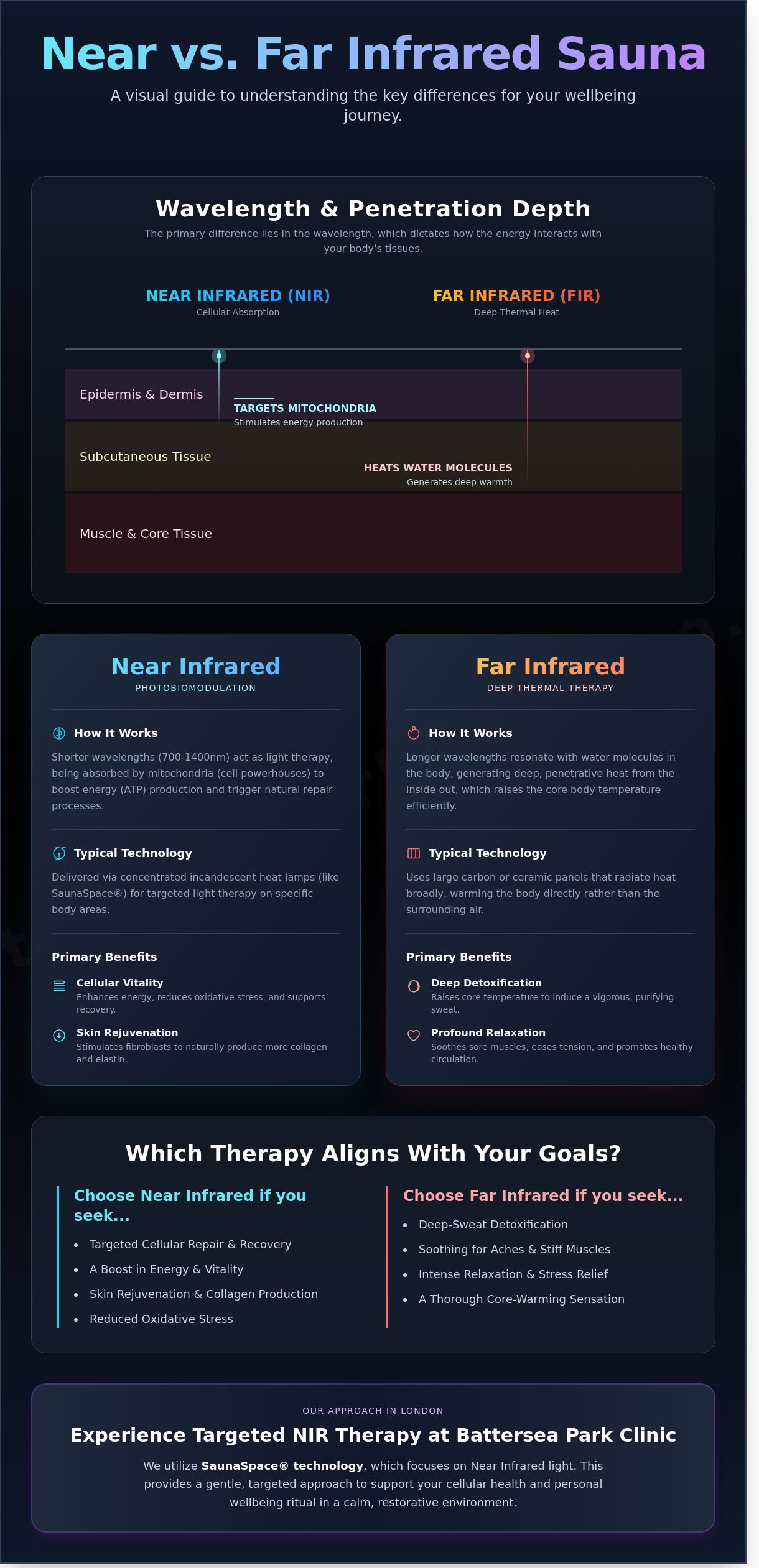
Near infrared light exists at the shortest wavelength of the infrared spectrum, typically ranging from 700 to 1,400 nanometres. Because these waves are shorter, they carry a higher energy frequency than other types of infrared. This energy doesn't just warm the surface of your skin; it travels into your tissues to trigger a biological process called photobiomodulation. When evaluating a near infrared vs far infrared sauna, it's helpful to understand that NIR behaves more like a targeted light therapy than a traditional heat source. It offers a gentle, supportive way to encourage the body's internal systems to find a state of balance.
You'll often find NIR delivered via incandescent heat lamps, such as those used by brands like SaunaSpace, rather than large carbon or ceramic panels. This is because lamps provide a concentrated beam of light and thermal energy. While panels distribute heat across a wider area, lamps allow for a more intense, localised application. This specific delivery method is ideal for those who want to focus on particular areas of the body for recovery or rejuvenation. It's a modern approach to wellness that fits perfectly into a mindful self-care routine.
Mitochondrial Support and Cellular Vitality
The primary benefit of NIR happens at a microscopic level. Within your cells, a protein called cytochrome c oxidase absorbs the light. This interaction encourages the mitochondria, the powerhouses of your cells, to produce more adenosine triphosphate (ATP). ATP is the essential fuel your body needs for every function, from muscle movement to tissue repair. By boosting cellular metabolism, NIR helps reduce oxidative stress and supports the body's natural ability to recover from daily strain. It’s a quiet, effective way to enhance your overall sense of vitality.
Skin Health and Collagen Production
Many people choose near infrared for its remarkable impact on skin health. The light penetrates the dermis to stimulate fibroblasts, which are the cells responsible for producing collagen and elastin. A study published in 2006 in the journal Photomedicine and Laser Surgery showed that participants experienced a 51% to 75% improvement in skin texture and tone after consistent light therapy sessions. This makes NIR a powerful tool for improving radiance and managing topical inflammation. If you're curious about the science behind these glows, our Red Light and Infrared Light Therapy pillar offers a deeper look into these benefits.
When weighing up the near infrared vs far infrared sauna experience, consider how NIR acts as a nurturing companion for your skin and energy levels. It's a wonderful way to begin your healing journey and support your body’s natural rhythms in a calm, restorative environment.
Far Infrared (FIR): Deep Detoxification and Core Warming
Far Infrared represents the longest wavelength in the infrared spectrum, typically ranging from 5.6 to 1,000 microns. Unlike traditional saunas that rely on high ambient heat to warm the skin, FIR energy penetrates up to 4 centimetres into the body's soft tissue. This process targets water molecules directly, causing them to vibrate and generate heat from within your core. When you evaluate near infrared vs far infrared sauna options, you'll find that FIR is the preferred choice for those seeking a deep, internal thermal experience that doesn't feel stifling or overly intense.
This technology creates a gentle rise in core temperature, which encourages the body to enter a state of serene relaxation. It's a supportive tool for anyone looking to incorporate a consistent wellbeing routine into their life. The heat is manageable and soothing, making it accessible for longer sessions that allow the body to fully surrender to the process. By warming you from the inside out, FIR helps you achieve a calmer, more supported state of being that lasts well beyond the session itself.
The Mechanism of Deep Tissue Detox
The sweat produced during an FIR session is chemically distinct from the sweat generated by exercise or steam. Research, including a notable study by Dr. Dietrich Klinghardt, suggests that FIR-induced sweat contains roughly 15% to 20% toxins, including heavy metals like lead, mercury, and cadmium. In contrast, sweat from a traditional sauna is usually 97% water. This deep thermal penetration mobilises environmental pollutants stored in fat cells, allowing your lymphatic system to process and eliminate them more efficiently. It's a principled approach to cleansing that respects the body's natural rhythms while providing necessary support.
Cardiovascular and Relaxation Benefits
FIR sessions provide a unique form of passive aerobic exercise that benefits your heart health without the impact of traditional training. As your body works to cool itself, your heart rate can rise to between 120 and 150 beats per minute, mimicking the physiological effects of a brisk walk. This induces vasodilation, which improves circulation and ensures oxygen-rich blood reaches your extremities. Clinical data from the Journal of the American College of Cardiology indicates that regular FIR use can significantly improve the function of the cells lining the blood vessels.
Cortisol Reduction: FIR heat helps to switch the nervous system from 'fight or flight' to 'rest and digest' modes.
Vitality: Improved blood flow supports cellular repair and leaves you with a sense of renewed energy.
Holistic Balance: The quiet environment of an FIR cabin provides a safe space for mind-body awareness.
By lowering cortisol levels and encouraging the release of endorphins, FIR helps you maintain a sense of vitality. It's an effective way to manage the daily pressures of life in the UK, offering a sanctuary where you can focus on your personal healing journey. Whether you're recovering from a busy week or looking to support your cardiovascular system, FIR provides a grounded, science-informed path to better health.
Near Infrared vs Far Infrared: A Comparative Framework
Choosing between wavelengths depends on your specific intentions for your wellbeing routine. Near infrared (NIR) consists of shorter wavelengths that primarily interact with the surface of your body. Research indicates that NIR light penetrates approximately 5mm into the dermal layers. Because NIR focuses on light energy rather than heat, the ambient air in the cabin typically stays between 40°C and 50°C. These sessions are often shorter, lasting around 15 to 20 minutes, making them a gentle addition to a busy morning.
Far infrared (FIR) operates differently by using longer wavelengths to reach deeper into the soft tissue. These waves penetrate 4cm to 5cm into the body, effectively raising your core temperature to stimulate a vigorous sweat. You will notice the ambient heat is higher here, often reaching 65°C. A standard FIR session lasts between 30 and 45 minutes to allow the body time to respond to the thermal stress. When evaluating a near infrared vs far infrared sauna, remember that one provides a topical glow while the other offers a deep, internal warmth.
Which One Should You Choose?
Your choice should align with your personal vitality goals. If you're an athlete prioritising muscle recovery, FIR is the more effective tool. A 2015 study published in the Journal of Athletic Enhancement found that deep penetrating heat can reduce muscle soreness by up to 47% after intense exercise. For those focused on anti-ageing, NIR is the better fit. Clinical trials in 2006 showed a 31% improvement in skin texture and collagen density after consistent exposure to near-infrared light. If you want the broadest range of benefits, a full-spectrum cabin allows you to experience both wavelengths in a single session.
Addressing the #1 Misconception: Is One 'Better'?
A common mistake is viewing these two technologies as competitors. It isn't a matter of one being superior; it's about how they complement your body's natural rhythms. NIR and FIR are partners in a holistic health journey. NIR works on the "outside-in" to support skin health and cellular energy, while FIR works "inside-out" to support circulation and relaxation. You don't have to choose a side to see results. Many people find balance by using FIR twice a week for deep rest and NIR on alternate days for a quick energy boost. This balanced approach ensures every layer of your body receives the support it needs.
Ready to discover a calmer, more supported state of being? Explore our personalised wellbeing experiences at Battersea Park Clinic and find the right balance for your lifestyle.
Integrating Infrared into Your London Wellbeing Ritual
At Battersea Park Clinic, we don't just offer heat; we provide a curated environment for deep restorative care. When deciding between a near infrared vs far infrared sauna, we've focused our approach on the targeted benefits of near-infrared (NIR) light. By using SaunaSpace technology, we deliver specific wavelengths that penetrate deeply into the tissues without the intense, often overwhelming heat of traditional cabins. This choice allows for a more comfortable experience that prioritises cellular resonance over simple perspiration.
Our methodology combines this light therapy with scalar energy to create a unique healing journey. We often suggest pairing your infrared time with our EESystem sessions. While the infrared lamps work on physical vitality and skin health, the Energy Enhancement System provides a bio-active field that encourages deep mental clarity and nervous system regulation. It's a layered approach to wellness that addresses both the physical and energetic bodies simultaneously.
To prepare for your session at our Battersea centre, we recommend hydrating well with at least 500ml of water two hours before you arrive. Wear comfortable, loose-fitting clothing that's easy to change out of. We provide a private, serene space where you can disconnect from the frantic pace of London life and reconnect with your inner sense of balance.
The Synergy of Light and Oxygen
Infrared therapy pairs perfectly with Hyperbaric Oxygen Therapy (HBOT). The gentle warming of the body through NIR light helps to support healthy circulation. This improved blood flow can help maximise the cellular uptake of oxygen during a subsequent HBOT session. Many of our clients organise their visit to include both modalities, creating a full afternoon of restorative care that leaves them feeling renewed rather than drained. This combination is particularly effective for those looking to support recovery after physical exertion or periods of high stress.
What to Expect at Battersea Park Clinic
Our clinic is a calm, supportive environment designed for deep rest. From the moment you enter, our wellness practitioners provide personalised guidance to ensure your session meets your specific needs. We've replaced the clinical feel of traditional health centres with a nurturing atmosphere that invites you to breathe and let go. We believe that high-quality wellbeing support should be accessible, affordable, and achievable for everyone in our community.
Ensuring these restorative services are easy for the community to find online is a vital part of that accessibility. For wellness professionals who wish to share their mission more effectively, you can visit Digital Med Spa to learn about specialized digital growth and website design.
Our team is here to support you at every step of your journey. Book your restorative infrared experience today and discover a more vibrant, balanced version of yourself.
Embrace Your Personal Radiance
Choosing between a near infrared vs far infrared sauna depends on your specific goals for vitality and rest. Near infrared provides targeted photobiomodulation to support cellular repair and mitochondrial health. In contrast, far infrared wavelengths penetrate up to 4 centimetres into the body to encourage a deep, detoxifying sweat and core warming. Both methods offer distinct paths to balance. At Battersea Park Clinic, we've established London's premier 24-unit EESystem centre to help you integrate these advanced technologies into a sustainable self-care routine. Our expert-led holistic wellness environment in SW11 focuses on your whole-person health, moving beyond simple treatments to create meaningful, personalised wellbeing experiences. Whether you're seeking to reduce inflammation or simply find a moment of stillness, our team is here to guide you. You deserve a space where science and serenity meet to support your natural healing processes. We invite you to step away from the bustle of the city and rediscover your inner strength in a nurturing atmosphere.
We look forward to supporting your transition to a more vibrant, energised version of yourself.
Frequently Asked Questions
Is near infrared or far infrared better for weight loss?
Far infrared is generally more effective for weight loss because it penetrates deeper into the body to raise your core temperature. A 2009 study at Binghamton University showed that participants using a far infrared sauna three times a week lost 4% body fat over a 16 week period. When comparing a near infrared vs far infrared sauna for metabolic support, the intense sweat from far infrared helpfully burns up to 600 calories in a single 40 minute session.
Can I use an infrared sauna every day as part of my routine?
You can safely incorporate a 20 to 45 minute infrared session into your daily self-care routine. Many of our clients find that daily use helps maintain a consistent sense of vitality and calm. It's important to listen to your body's signals; if you feel lightheaded, you should reduce your frequency to three times a week until your system adjusts to the gentle, supportive heat.
Is near infrared light therapy safe for my eyes?
Near infrared light is safe for the skin, but you shouldn't stare directly into the light source for long periods. Near infrared wavelengths typically range from 700 to 1400 nanometres. While these aren't inherently harmful, the brightness can occasionally cause temporary eye strain. We recommend wearing the provided safety goggles if you plan to keep your eyes open during a targeted light session to ensure your experience remains relaxing.
What is the difference between a red light sauna and near infrared?
Red light therapy focuses on the visible spectrum to support surface skin health, while near infrared reaches deeper into the muscles and joints. Red light uses wavelengths between 630 and 700 nanometres to boost collagen. When looking at the near infrared vs far infrared sauna technology, near infrared operates at slightly longer wavelengths than red light to promote cellular repair and reduce inflammation deeper within the body's tissues.
How much water should I drink before and after an infrared session?
You should drink at least 500ml of water before you enter the sauna and another 750ml once your session ends. Proper hydration is vital because a single 30 minute session can cause you to lose up to 1 litre of fluid through perspiration. Adding a pinch of sea salt or electrolytes to your water helps replenish the essential minerals lost during your deep, cleansing sweat.
Does infrared therapy interfere with medical implants or devices?
Infrared therapy can affect certain medical devices, so you must speak with your GP if you have a pacemaker or surgical implants. Metal pins, rods, or artificial joints generally reflect infrared waves, but they can still absorb heat in the surrounding tissue. Our team prioritises your safety and follows a strict protocol to ensure your wellbeing journey aligns with your specific medical history and physical requirements.
What should I wear during my infrared sauna session in Battersea?
We recommend wearing clean swimwear or lightweight, loose-fitting cotton clothing for your session at our Battersea clinic. Since the infrared light needs to contact your skin to be most effective, less coverage is often better for your results. We provide fresh, organic cotton towels for you to sit on, ensuring your experience is as comfortable and hygienic as possible in our nurturing environment.
How long does it take to see results from infrared light therapy?
Most people feel a sense of profound relaxation and mental clarity after just one 30 minute session. However, visible improvements in skin clarity or chronic pain relief typically require a consistent routine of two sessions per week over a 6 week period. By your tenth visit, you'll likely notice a sustained increase in your energy levels and a more balanced mood as the cumulative benefits take hold.

Comments