How to Recover from Burnout in the UK: A Holistic 2026 Guide to Restoring Vitality
- alastair208
- Apr 12
- 13 min read
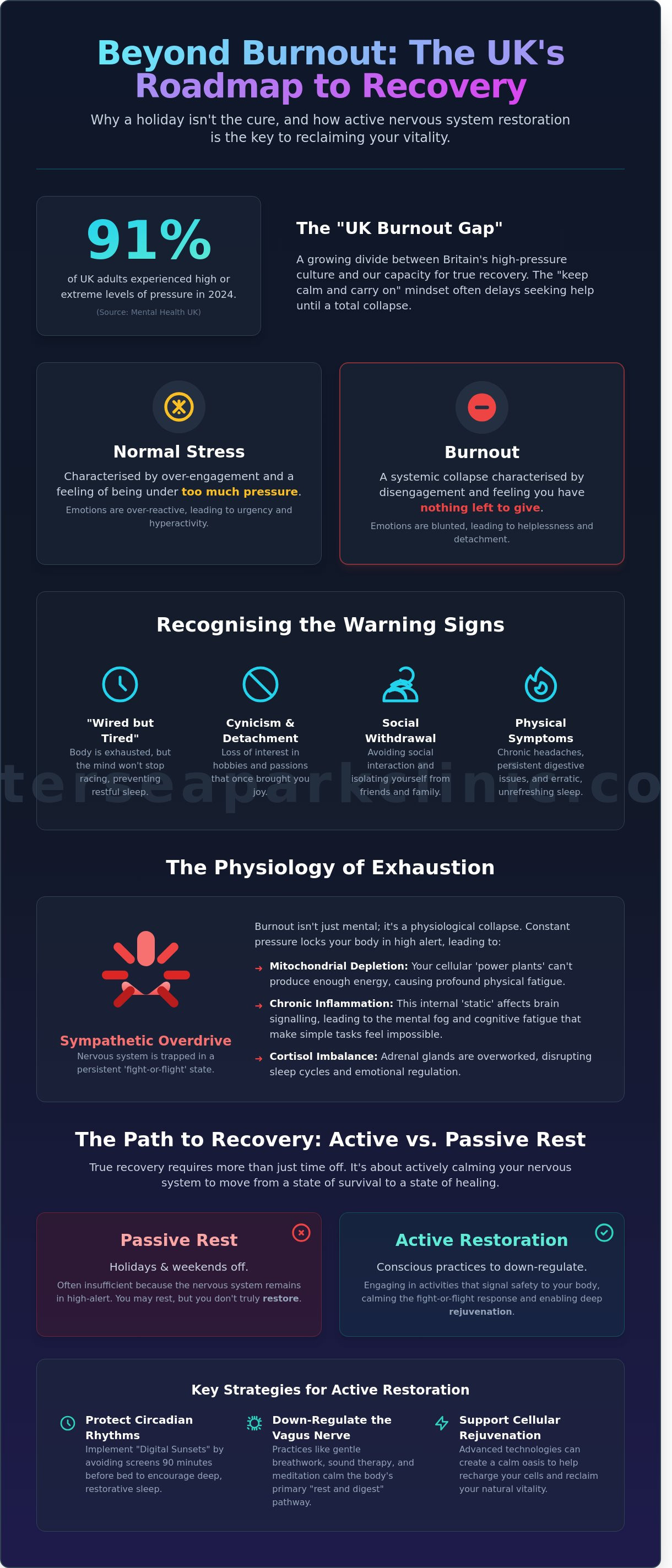
What if the traditional advice to "just take a holiday" is actually making your exhaustion worse? Recent 2024 data from Mental Health UK reveals that 91% of adults in Britain experienced high or extreme levels of pressure, yet many find that a simple week away fails to lift the heavy fog. You likely know the feeling of being "wired but tired," where your body is heavy but your mind won't stop racing. It's frustrating when your once-loved passions spark only cynicism and simple tasks feel impossible to start. Understanding how to recover from burnout uk requires a shift from passive resting to active nervous system restoration.
We're here to provide a science-informed roadmap to help you reclaim your energy and restore your cognitive function. This guide offers a compassionate path to moving beyond brain fog and building a lifestyle that supports your long-term wellbeing. You'll learn how to cultivate emotional resilience through gentle, holistic practices that fit into your daily routine. Let's explore the practical steps you can take today to rediscover your vitality and ensure your recovery is both deep and lasting.
Key Takeaways
Learn why burnout is a systemic collapse of the nervous system and how to recognise the transition from "normal stress" into a state of sympathetic overdrive.
Discover a science-informed roadmap on how to recover from burnout uk by prioritising active physiological restoration over simple passive rest.
Understand why nutrition alone is often insufficient for recovery and how to address the three essential pillars of whole-person wellbeing.
Identify your personal energy leaks and implement "Digital Sunsets" to protect your circadian rhythm and encourage deep, restorative sleep.
Explore how advanced technology like the EESystem can provide a calm oasis for cellular rejuvenation and help you reclaim your natural vitality.
Table of Contents Understanding Burnout in the UK: Why Traditional Rest Isn't Always Enough The Physiology of Exhaustion: How Burnout Impacts Your Nervous System Moving Beyond 'Time Off': A Holistic Framework for True Recovery Practical Steps to Organise Your Recovery Journey in the UK Rejuvenating at Battersea Park Clinic: Advanced Support for Burnout Recovery
Understanding Burnout in the UK: Why Traditional Rest Isn't Always Enough
Burnout in 2026 has evolved into more than just a case of overwork; it's a profound systemic collapse of our physical, mental, and emotional reserves. While normal stress involves being under too much pressure, burnout is the feeling of having nothing left to give. Understanding how to recover from burnout uk requires us to look beyond the surface of a busy schedule. It's a state of complete depletion that impacts the very core of our vitality. Many people mistake this for standard fatigue, yet a weekend of sleep rarely fixes the underlying issue. This is because burnout impacts the nervous system directly, leaving it stuck in a state of high alert. For a deeper look at the clinical definition and the various ways it manifests, Understanding Occupational Burnout helps clarify how this syndrome differs from general anxiety or temporary exhaustion.
The "UK Burnout Gap" describes the growing space between our high-pressure professional culture and our actual capacity for recovery. In Britain, the "keep calm and carry on" mindset often prevents us from seeking support until a total collapse occurs. We often rely on passive sleep, hoping eight hours in bed will reset us. However, true recovery requires active restoration. This involves engaging in practices that consciously calm the sympathetic nervous system, helping you move from a state of survival into a state of healing and balance.
Recognising the Signs: Behaviour and Physical Cues
The shift often starts with your emotional state. You might find your previous passion for your career has turned into cynicism or a heavy sense of detachment. Physically, your body sends clear signals that it's struggling to cope. These include:
Chronic headaches and persistent digestive issues.
A "wired but tired" feeling where you're exhausted but your mind won't stop racing.
Social withdrawal and a loss of interest in hobbies that once brought joy.
Erratic sleep patterns that leave you feeling unrefreshed in the morning.
The 2026 Burnout Landscape in London
Data from late 2025 suggests that 82% of London professionals feel digitally saturated, with the average worker checking notifications every 6 minutes. This constant connectivity means a standard week-long holiday often fails to reset the nervous system. You spend three days winding down and the final two days dreading the return to your inbox. In the UK, caregiver fatigue has also risen by 14% over the last two years, adding another layer of pressure to the modern British professional. Learning how to recover from burnout uk involves creating a sustainable wellbeing routine that exists outside of a simple vacation. It's about finding a supportive environment where your body can finally feel safe enough to begin its natural healing journey.
The Physiology of Exhaustion: How Burnout Impacts Your Nervous System
Burnout isn't just a state of mind; it's a physiological shift where your Autonomic Nervous System (ANS) loses its natural ability to self-regulate. When you're under constant pressure, your body can become trapped in 'Sympathetic Overdrive.' This is a persistent state of fight-or-flight where your system remains on high alert even when you're trying to rest. Your adrenal glands continue to signal for cortisol, keeping your heart rate elevated and your muscles tense. This constant demand eventually leads to mitochondrial depletion, where the tiny power plants inside your cells can no longer produce enough energy to keep up with your needs.
A 2021 UK Government Evidence on Burnout review highlights that targeted interventions are essential to prevent long-term health decline in high-risk individuals. Without these interventions, the body often enters a state of chronic low-grade inflammation. This inflammation affects the brain's signalling, creating the 'mental fog' and cognitive fatigue that makes daily tasks feel insurmountable. Understanding how to recover from burnout uk involves more than just taking a holiday; it requires a dedicated approach to down-regulating your nervous system and clearing this internal 'static.'
The Vagus Nerve and Emotional Regulation
The vagus nerve acts as the primary highway for your parasympathetic nervous system, responsible for the 'rest and digest' response. If you've been stressed for a long time, you might develop a 'low vagal tone,' which means your body has forgotten how to relax effectively. Because this nerve connects the brain to the gut, burnout often manifests as digestive discomfort or a 'heavy' feeling in the stomach. You can begin to improve your vagal tone at home with simple, gentle practices:
Splashing your face with cold water to trigger the mammalian dive reflex.
Practising rhythmic, diaphragmatic breathing to signal safety to the brain.
Gentle humming or chanting, which vibrates the vocal cords near the vagus nerve.
Cellular Energy and Bio-Photonics
At the most fundamental level, your vitality depends on bio-photons. These are ultra-weak light emissions from your cells that facilitate internal communication and health. Modern life in the UK often involves high exposure to environmental stressors like air pollution and EMFs from constant connectivity, which can disrupt these delicate light signals and drain your cellular battery. Restoring this balance is a key part of a holistic recovery programme. Many of our clients find that the Energy Enhancement System provides a supportive environment for this cellular recharge, using scalar waves to help the body return to its natural, high-energy frequency. If you're ready to move beyond simple rest, exploring a personalised wellbeing experience can help you rebuild your energy from the inside out.
Moving Beyond 'Time Off': A Holistic Framework for True Recovery
Recovery isn't a passive event; it's an active recalibration of your entire system. Many people think a week on a beach solves the problem, yet 2024 data from Mental Health UK shows that 91% of adults experienced high or extreme levels of pressure in the past year. Real healing requires more than a temporary pause. It demands a framework built on three essential pillars: a physiological reset, an environmental shift, and deep emotional support.
When you're learning how to recover from burnout uk, you'll find that traditional advice often skips the body. You might be taking high-quality supplements, but if your nervous system is stuck in a chronic "fight or flight" state, your digestive system effectively shuts down. The body won't absorb those nutrients if it's diverted all energy to survival. This is why "non-doing" is a vital skill. In a culture that values constant productivity, doing nothing feels transgressive. However, it's the only way to signal to your brain that the threat has passed.
While the Mental Health Foundation's guide to burnout provides excellent foundational strategies for cognitive recovery, many London professionals find that talking therapies alone aren't enough. Somatic and energetic approaches go deeper. They address the physical imprints of stress stored in the fascia and nervous system, offering a path to vitality that words cannot always reach. By moving beyond the "why" and addressing the "how" your body holds stress, you create a sustainable foundation for long-term health.
The Power of Scalar Waves and Bio-Photonic Light
Scalar waves provide a unique environment for the body to exit the stress response. By immersing yourself in a 24-unit EESystem centre, you're surrounding your cells with bio-photonic light and longitudinal waves that encourage deep, meditative rest. This technology doesn't "fix" you; instead, it creates the ideal conditions for your own biology to return to balance. True recovery begins when the body feels safe enough at a cellular level to stop defending and start repairing. These sessions help recalibrate the nervous system, allowing you to move from a state of depletion to one of renewed energy.
Oxygen and Vitality: The Role of HBOT
Mental fatigue and "brain fog" are often results of systemic inflammation. Hyperbaric oxygen therapy supports brain recovery by delivering high-pressure oxygen directly into the blood plasma. This process helps reduce inflammation and encourages the repair of neural pathways damaged by chronic stress. It's a preferred choice for London professionals who need to restore mental clarity and physical stamina as part of their wellbeing routine. By increasing oxygen saturation, you're giving your mitochondria the fuel they need to pull you out of the burnout fog and back into a state of vitality.
Practical Steps to Organise Your Recovery Journey in the UK
Understanding how to recover from burnout uk involves more than just booking a week off work; it's a structured process of reclaiming your physiological and emotional resources. According to 2024 data from the Health and Safety Executive (HSE), 875,000 workers in the UK suffer from work-related stress, depression, or anxiety. To move beyond these statistics, you must first audit your energy leaks. This means identifying the specific people, tasks, and habits that deplete you. It's often the small, recurring drains, like an overflowing inbox or a lack of boundaries with colleagues, that prevent true restoration.
Building a 'Wellbeing Team' is another vital component. Rather than trying to navigate this journey alone, incorporate specialists such as nutritional therapists, somatic practitioners, and GP support. This collaborative approach ensures you aren't carrying the burden of your own recovery. Protecting your circadian rhythm is equally essential. Implementing a 'Digital Sunset' by turning off screens 90 minutes before bed helps regulate melatonin production, which is frequently disrupted by the chronic high-cortisol states associated with burnout.
Nutrition and Hydration for a Depleted Body
Chronic stress rapidly depletes essential minerals like Magnesium and Potassium, which are crucial for nervous system regulation. When you're in a state of burnout, your digestive system often slows down, a condition sometimes called 'stress-gut'. This makes it harder to absorb nutrients from food alone. Many individuals find that IV drips provide a helpful solution by bypassing the gut to deliver immediate vitality and cellular balance. Complementing this with a weekly 20-minute 'Detox Bath' using Epsom salts can further assist in clearing metabolic waste and soothing tired muscles.
Somatic Practices: Numa and Breathwork
Recovery isn't just a mental process; it's a physical one. Traditional talk therapy is helpful, but emotional tension is often stored deep within the body's tissues. When exploring how to recover from burnout uk, focus on small, sustainable shifts rather than drastic overhauls. Practising Numa breathwork helps release these stored blockages through conscious breathing and somatic exploration. You should integrate movement that restores rather than depletes. While high-intensity interval training (HIIT) might feel productive, it can further spike cortisol. Instead, opt for gentle yoga or restorative walking to honour your current energy capacity.
If you're ready to move from exhaustion to lasting balance, you can start your healing journey at Battersea Park Clinic to explore a personalised path forward.
Rejuvenating at Battersea Park Clinic: Advanced Support for Burnout Recovery
Finding a space to breathe in the heart of London can feel impossible when you're physically and emotionally exhausted. Battersea Park Clinic serves as a calm oasis, providing a sanctuary for those seeking how to recover from burnout uk through a gentle, technology-led approach. Our core protocol isn't about clinical interventions; it's about creating a quiet space where your body can find its natural state of balance. The centre is designed to be a nurturing environment, moving away from the sterile feel of traditional medical facilities to offer something truly restorative.
The immersive EESystem experience sits at the heart of our burnout recovery support. This advanced technology uses custom-installed computers to generate bioactive energy fields, including scalar waves. During a session, you simply sit in a comfortable chair and rest. It's a non-invasive way to encourage deep relaxation and mind-body awareness. We've found that for many clients, this profound stillness is the missing piece in their recovery journey. To enhance this process, we offer a range of complementary therapies under one roof:
Hyperbaric Oxygen Therapy (HBOT): Providing a concentrated oxygen environment to support natural vitality.
Red Light Therapy: Using specific wavelengths to encourage a sense of renewal.
Infrared Sauna: Promoting gentle detoxification and muscle relaxation through soothing heat.
By combining these services, we help you avoid the stress of travelling to multiple locations. Everything you need for a restorative afternoon is available in one serene setting, allowing you to focus entirely on your wellbeing.
Your Personalised Wellbeing Routine
We believe that recovery should be "Accessible. Affordable. Achievable." Our team helps you design a plan that fits into your life without adding more pressure to your schedule. We don't see these sessions as medical treatments; instead, we view them as essential parts of a modern self-care routine. Our 24-unit EESystem is a unique asset for London's wellness community, offering a high-density energy environment that's difficult to find elsewhere in the UK. It's a tool for anyone seeking a calmer, more supported state of being.
Ready to Begin Your Healing Journey?
Taking the first step is often the most difficult part of learning how to recover from burnout uk. We invite you to visit us and experience our supportive and reassuring environment firsthand. Whether you're feeling a slight dip in energy or total exhaustion, our doors are open. You don't need a referral or a complex reason to visit; you just need a desire for rest and renewal. Our staff are here to guide you through each session with compassion and clarity.
Take a breath and start your recovery today.
Step Into a Life of Lasting Vitality
Recovery isn't just a destination; it's a deliberate return to your natural state of balance. The 2024 Mental Health UK Burnout Report revealed that 91% of adults experienced high or extreme levels of pressure in the past year. This data highlights why traditional rest often falls short when your nervous system is deeply depleted. True restoration requires a whole-person approach that addresses the physiological roots of exhaustion. Understanding how to recover from burnout uk means moving beyond temporary fixes and embracing science-informed, non-invasive therapies that support your body's innate ability to heal.
At Battersea Park Clinic, we offer a serene sanctuary designed for this exact purpose. As London's premier 24-unit EESystem centre, we provide a holistic environment that prioritises your vitality through advanced technology and compassionate care. Our approach focuses on restoring your energy levels and helping you reconnect with yourself in a calm, supportive space. You don't have to navigate this journey alone. It's time to rediscover the vibrant, balanced version of yourself.
Frequently Asked Questions
How long does it typically take to recover from burnout?
Recovery times vary for every individual, but research from Mental Health UK suggests most people require between 3 and 18 months to fully restore their vitality. The duration depends on the severity of your exhaustion and how quickly you can implement supportive lifestyle changes. You might notice your sleep patterns improving within 4 weeks, while cognitive clarity and emotional resilience often take longer to return. It's a journey that requires patience and consistent self-care.
Is burnout a medical condition that requires a GP visit in the UK?
Burnout isn't classified as a diagnosable medical condition in the UK, but visiting your GP is a vital step in your recovery. The World Health Organization defines it as an occupational phenomenon rather than a disease. However, a professional consultation helps rule out underlying physical issues like iron deficiency or thyroid imbalances. Statistics show that roughly 20% of UK GP consultations involve fatigue, so your doctor is well-equipped to provide the necessary initial guidance.
Can scalar wave therapy really help with mental exhaustion?
Scalar wave therapy helps by creating a deeply restorative environment that encourages your nervous system to shift out of a "fight or flight" state. While it's a non-medical wellbeing tool, the Energy Enhancement System (EESystem) provides a space for profound relaxation and mental stillness. Many visitors find that spending time in this energy field helps quieten the persistent mental chatter associated with burnout. It serves as a gentle, modern addition to a broader holistic recovery routine.
How many sessions of HBOT are recommended for burnout recovery?
Most people find that a series of 10 to 20 sessions of Hyperbaric Oxygen Therapy (HBOT) provides the most significant support for their wellbeing. These sessions are typically scheduled over a 4 to 6 week period to establish a consistent rhythm of restoration. Each 60-minute experience allows you to breathe pure oxygen in a pressurised setting, which helps you feel more refreshed. This structured approach is a popular choice for those exploring how to recover from burnout uk effectively.
What is the difference between burnout and clinical depression?
The main difference is that burnout is usually tied to specific situational stressors, such as your workplace or a caregiving role. Clinical depression is a broader mental health condition that affects all areas of life, regardless of your environment. According to NHS guidelines, burnout symptoms often ease when you're away from the stressor, such as during a holiday. If your low mood persists even during rest periods, it's important to seek a professional clinical assessment.
Can I continue working while recovering from burnout?
You can continue working, but success often requires a phased return or a reduction in your responsibilities. Data from the Health and Safety Executive (HSE) shows that 875,000 UK workers experienced work-related stress or burnout in 2022/23. Many employers now offer supportive adjustments to help staff stay in post while they heal. Prioritising clear boundaries and taking regular breaks is essential if you choose to remain at work while following a recovery plan.
Is the EESystem safe for everyone to use during recovery?
The EESystem is a non-invasive wellbeing technology that's considered safe for the vast majority of people seeking rest. It doesn't use chemicals or medical procedures, instead relying on light and energy frequencies to foster a sense of balance. It's a gentle option for those who feel too fragile for more intense therapies. We always suggest you consult your healthcare provider if you have specific concerns or medical implants to ensure the experience aligns with your personal health needs.
What are the first signs that my burnout recovery plan is working?
Improved sleep quality and a more stable mood are usually the first indicators that your recovery plan is taking effect. You might find you're waking up feeling less heavy or that you have the energy to engage in a hobby for 30 minutes. Another positive sign is a return of curiosity about the world around you. When you focus on how to recover from burnout uk through holistic methods, these small shifts in daily vitality confirm you're moving toward balance.


Comments