
Red Light Therapy for Seasonal Affective Disorder: A Gentle Guide to Winter Wellbeing
- alastair208
- 19 hours ago
- 12 min read
Your standard SAD lamp might brighten your room, but it often stops at the surface. While bright light therapy is the first-line recommendation for the 2 million people in the UK living with winter blues, many find that simply mimicking the sun isn't enough to truly lift the "gray" feeling of a London winter. You've likely felt that persistent low energy and the frustration of disrupted sleep patterns as the days shorten. It is a common experience, but it doesn't have to be your permanent winter state.
In this guide, we explore how red light therapy for seasonal affective disorder provides a gentle, bio-active way to support your mood and vitality at a cellular level. We'll show you how this calming self-care ritual can help you feel more awake and vibrant. You'll learn the difference between standard light boxes and red light, and how a 20-minute session for just £30 can help restore your natural balance and improve your sleep quality during the darkest months. Discover how to transition from simply enduring the winter to nurturing your wellbeing with intention.
Key Takeaways
Learn why red and near-infrared wavelengths provide a different type of support compared to the high-intensity white light found in standard SAD lamps.
Discover how photobiomodulation works at a cellular level to nurture your mitochondria and boost your natural vitality during the shorter days.
Understand how to incorporate red light therapy for seasonal affective disorder into a personalized self-care routine that protects your sleep and mood.
Explore the benefits of creating a structured winter wellness ritual to help align your biological clock with your daily life.
Find out how a serene clinic environment can transform a simple light session into a restorative experience for your mind and body.
Table of Contents Understanding Seasonal Affective Disorder and the Power of Light Red Light Therapy vs. SAD Lamps: Which is Right for You? Beyond the Surface: How Red Light Supports Winter Vitality Creating a Winter Wellness Ritual in London Red Light Therapy at Battersea Park Clinic: A Nurturing Escape
Understanding Seasonal Affective Disorder and the Power of Light
The London winter often arrives with a heavy, persistent grayness. As the sun sets before 4:00 PM during the shortest days, many of us feel a corresponding dip in our internal energy. This isn't just a lack of motivation; it's a physical response to the environment. Understanding Seasonal Affective Disorder helps us see that these shifts are tied directly to our biological clocks. When daylight hours shrink, our bodies can struggle to maintain their natural rhythm. This leads to a state where we feel out of sync with the world around us, often resulting in a lingering sense of fatigue.
Using red light therapy for seasonal affective disorder offers a gentle, non-invasive way to bridge this gap. Instead of forcing your body to "power through" the exhaustion, light therapy provides the supportive environment your cells need to maintain vitality. It's a way to bring a sense of balance back into your daily routine when the natural world feels a bit dim. By providing specific wavelengths of light, we can support the body's natural processes in a way that feels nurturing rather than clinical.
The "Winter Blues" vs. Seasonal Affective Disorder
Seasonal low mood exists on a broad spectrum. While some experience clinical symptoms, many others deal with what is commonly called the "winter blues." You might notice your limbs feel unusually heavy or that a persistent "brain fog" makes simple tasks feel daunting. These aren't signs of failure. They are signals from your body. In the UK, approximately 2 million people are affected by these seasonal shifts. Your body is essentially asking for more rest and restorative light to compensate for the lack of outdoor exposure during the colder months.
How Light Influences Our Internal Rhythm
Our bodies rely on light to regulate the production of serotonin and melatonin. Serotonin helps us feel awake and balanced, while melatonin prepares us for rest. When we spend our days under artificial office lights and our evenings in the London gloom, these rhythms get disrupted. Modern indoor lifestyles mean we often miss the specific wavelengths of light that keep our internal clocks accurate. Practicing good "light hygiene" involves intentionally seeking out beneficial light. By integrating red light therapy for seasonal affective disorder into your self-care ritual, you help signal to your body that it's time to feel vibrant and awake, even when the sky outside remains gray.
Red Light Therapy vs. SAD Lamps: Which is Right for You?
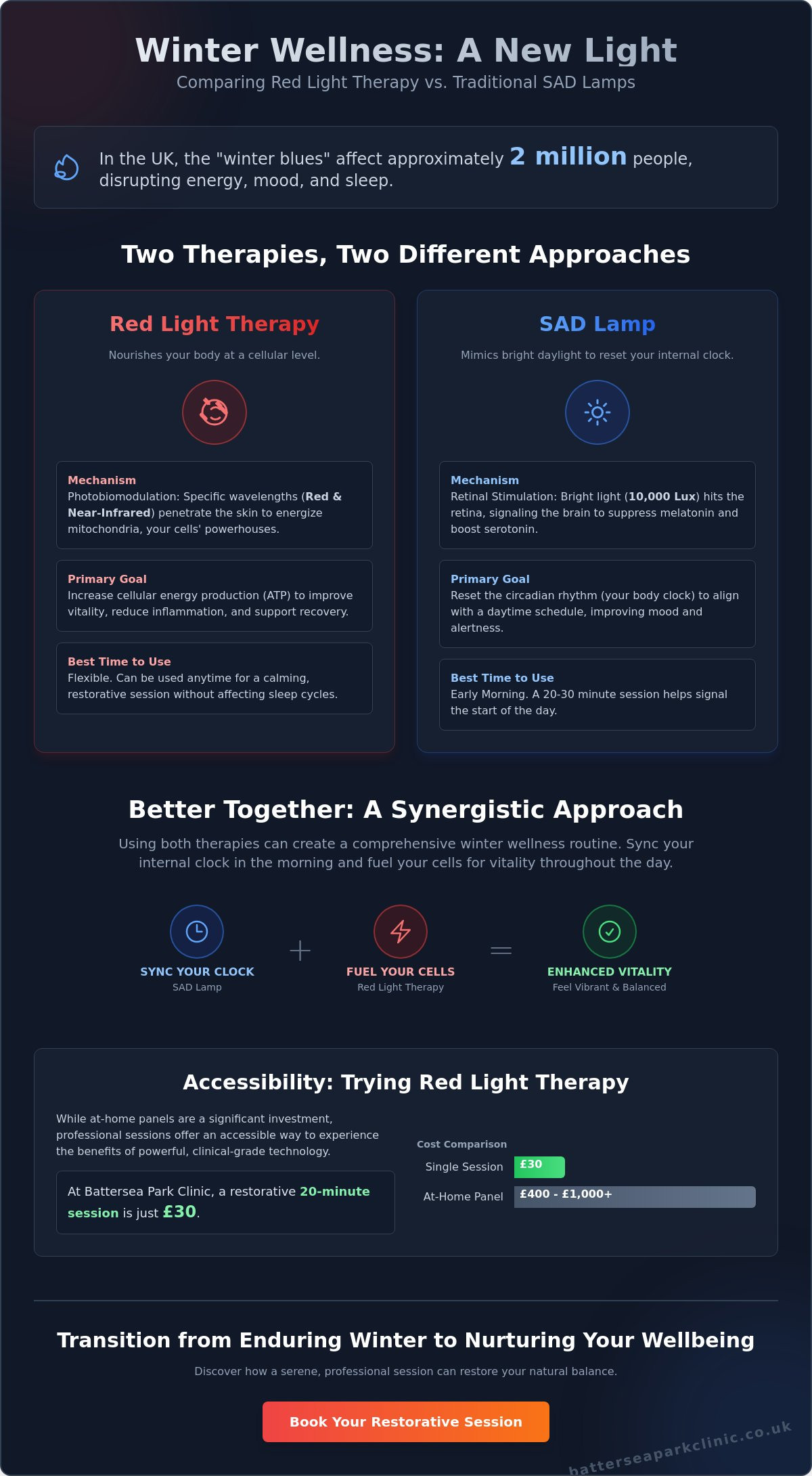
When looking for ways to brighten the winter months, many people assume all light therapy is the same. It's a common misconception. Standard SAD lamps and red light therapy serve different purposes within a personal wellbeing routine. A standard SAD lamp is designed to mimic a bright spring morning. To be effective, these devices typically provide 10,000 lux of cool, white light. While a significant review found that morning bright light therapy resulted in remission rates of around 60% for winter SAD, it primarily focuses on resetting your internal clock through your eyes. Red light therapy for seasonal affective disorder operates on a different principle entirely. It isn't about the intensity of the light, but rather the specific wavelengths that nourish your body at a cellular level.
The Mechanism: Lux vs. Wavelength
The primary difference lies in how your body receives the light. SAD lamps rely on "lux," which is a measure of perceived brightness. When this light hits your retina, it signals your brain to stop producing melatonin and start producing serotonin. It's a wake-up call for your mind. Red light therapy doesn't focus on brightness. Instead, it uses red and near-infrared wavelengths that penetrate the skin. This process, known as photobiomodulation, supports the mitochondria, which are the powerhouses of your cells. While the SAD lamp tells your brain it's daytime, red light helps your body's cells produce the energy they need to keep you feeling vibrant.
Choosing Your Approach
You don't necessarily have to choose one over the other. Many individuals find that these two approaches are most effective when used together. A SAD lamp is best used for 20 to 30 minutes in the early morning to help sync your circadian rhythm. Red light therapy is more flexible. You can enjoy a session at any time of day to support relaxation and recovery. While mid-range at-home panels can cost between £400 and £1,000, a professional session provides a much more immersive experience. At Battersea Park Clinic, a 20-minute session is priced at £30, offering an accessible way to integrate this technology into your life. If you're feeling the weight of the season, a personalized wellbeing experience can help you reclaim your sense of vitality without the high upfront cost of home equipment. Combining these tools creates a comprehensive support system for both your mind and your body.
Beyond the Surface: How Red Light Supports Winter Vitality
While the previous sections explored how light resets your internal clock, we must look deeper into the body to understand why light is so transformative. The science behind this is called photobiomodulation. This term describes how specific wavelengths of light interact with your cells to encourage natural healing and energy production. It's a quiet, powerful process that goes far beyond the surface of your skin. By using red light therapy for seasonal affective disorder, you aren't just looking at a light; you're allowing your body to absorb "bio-active" energy that it might otherwise lack during the London winter.
This interaction happens primarily within the mitochondria, which are often called the powerhouses of your cells. During the darker months, many people experience a sense of physical and mental stagnation. Your body feels heavy and your thoughts can feel sluggish. This is often a sign that your cellular energy is low. Red light helps stimulate these powerhouses, providing the support needed to lift that heavy feeling and restore a sense of natural flow to your day. It's about building resilience from the inside out.
Energizing the Body at a Cellular Level
Adenosine Triphosphate, or ATP, acts as the primary currency of vitality for every cell in your body. When your cells have an abundant supply of ATP, you feel more capable, awake, and resilient. Winter often brings a dip in this cellular "currency," leading to the listlessness we associate with the season. Red light therapy for seasonal affective disorder helps bridge this gap by encouraging the mitochondria to produce ATP more efficiently. This isn't the jittery energy you get from caffeine. Instead, it's a calm, renewed energy that supports your ability to navigate daily life with a sense of ease. Many clients describe feeling a subtle "glow" of vitality that stays with them long after their session ends.
Calming the Stress Response
Winter isn't just about low energy; it's also a time when our nervous systems can feel frayed and overstimulated. The lack of natural sunlight can keep us in a state of low-level stress. Red and near-infrared light have a soothing, warming effect that helps shift your body into a "parasympathetic" state. This is the "rest and digest" mode where true healing and mood regulation occur. By calming the nervous system, you create a foundation for better sleep and a more stable mood. For those seeking even deeper systemic support, exploring infrared light therapy can be a wonderful addition to your self-care routine. This holistic approach ensures that your body feels supported, warm, and nurtured throughout the coldest months of the year.
Creating a Winter Wellness Ritual in London
Navigating the London winter requires more than just resilience; it requires a structured approach to self-care. When the sun hides behind layers of gray clouds for weeks on end, our internal systems need external anchors to maintain balance. A dedicated ritual helps you reclaim a sense of control over your wellbeing. It's not just about the light itself, but the act of choosing to nurture yourself. Integrating red light therapy for seasonal affective disorder into a weekly routine provides a predictable source of vitality when the outside world feels unpredictable and dim.
Stepping out of your home or office for a professional session provides a psychological "reset" that at-home devices often lack. While at-home panels are becoming more popular, with the UK light therapy market projected to reach USD 43.2 million by 2030, a clinic visit offers a necessary escape. By visiting a dedicated wellness space, you separate yourself from the demands of daily life. This physical transition signals to your brain that it's time to rest and receive. It transforms a simple session into a restorative experience that anchors your entire week.
A Day of Supportive Light
A balanced day starts with seeking natural light as early as possible. Even on a typical overcast London morning, outdoor light levels are significantly higher than indoor lighting. In the afternoon, when energy levels often dip, a restorative session at a healing clinic near me can provide the bio-active boost needed to carry you through the evening. As night falls, focus on "light hygiene" by reducing blue light from screens. This supports your natural melatonin production, ensuring the work you did during the day translates into deep, restorative sleep.
Complementary Wellness Practices
Light is only one part of the winter wellness puzzle. Maintaining cellular health also requires proper hydration and nourishment, which can be challenging during the colder months. Many find that incorporating IV drips into their routine helps restore essential balance and supports the immune system. Gentle movement and somatic breathwork, such as Numa, can further release the physical tension that often accompanies the "winter blues." At home, you can mirror the comfort of a clinic by creating a "hygge" environment with soft textures and warm tones. This holistic approach ensures every aspect of your lifestyle supports a calmer, more vibrant state of being.
If you're ready to move beyond the gray and support your body's natural vitality, we invite you to book your winter wellness session and begin your healing journey in a safe, nurturing environment.
Red Light Therapy at Battersea Park Clinic: A Nurturing Escape
Battersea Park Clinic serves as a quiet sanctuary away from the rush of the city. While we've discussed the science of light, the environment in which you receive it is equally important. Our wellness centre is designed to be a supportive space where you can step away from the gray London sky and focus entirely on your self-care. We don't just offer standalone services; we provide a holistic environment that nurtures the whole person. This is why red light therapy for seasonal affective disorder is often experienced alongside our flagship Energy Enhancement System. This combination creates a field of restorative energy that supports your mind and body simultaneously.
Our approach is fundamentally non-medical and principled. We believe that wellbeing is a personal journey that requires a safe and nurturing environment. By focusing on vitality rather than clinical outcomes, we help you connect with your body's natural rhythms. The 24-unit EESystem immersion provides a level of deep relaxation that is difficult to replicate elsewhere. It encourages a state of mind-body awareness that helps you feel more grounded and resilient throughout the winter months.
An Immersive Healing Journey
A small home panel can be a helpful addition to your routine, but it cannot mirror the immersive experience of a professional clinic. In our space, you're surrounded by technology designed for deep support. This environment allows you to reach a calmer, more supported state much faster than you might at home. You aren't just using a device; you're entering a "London oasis" dedicated to your restoration. We invite you to experience "vitality through light" in a setting that values your peace and comfort above all else.
Personalised Wellbeing Experiences
Every journey is unique, and we offer the flexibility to tailor your visit. You might choose to combine your session with Hyperbaric Oxygen Therapy for a truly comprehensive wellness experience. During your first visit, our team will guide you through the process, ensuring you feel comfortable and informed. Using professional red light therapy for seasonal affective disorder as part of a broader routine allows you to maintain your vitality even when the days are shortest. A 20-minute session is priced at £30, making this advanced technology an accessible part of your regular self-care. We're here to act as a thoughtful guide on your path to better health. Ready to begin your healing journey? We invite you to connect with us and discover a new era of wellbeing this winter.
Step Into Your New Era of Wellbeing
Winter in London often feels like a long season of endurance, but you have the power to shift your internal state with intention. We've explored how light serves as a vital nutrient for your cells, moving beyond the surface to support your mitochondria and overall resilience. By choosing red light therapy for seasonal affective disorder, you embrace a gentle way to restore your natural balance and wake up your body's innate vitality. It's about moving from a state of stagnation to one of renewed flow and mind-body awareness during the darkest months of the year.
At Battersea Park Clinic, we offer London’s premier 24-unit EESystem centre to provide a truly immersive experience that at-home panels simply can't match. Our compassionate, holistic approach ensures you feel supported and heard throughout your journey. We remain committed to our mission of making wellness Accessible. Affordable. Achievable. for every member of our community. You don't have to navigate the gray months alone when a nurturing oasis is waiting for you in the heart of the city.
Begin Your Winter Healing Journey: Book a Session at Battersea Park Clinic. We look forward to welcoming you into our calm, supportive environment and helping you reclaim your sense of vibrant wellbeing.
Frequently Asked Questions
Is red light therapy the same as a SAD lamp?
No, red light therapy and SAD lamps are different technologies. A standard SAD lamp provides 10,000 lux of bright white light to mimic morning sun through your eyes. Red light therapy uses specific wavelengths to support cellular energy. While SAD lamps focus on resetting your brain's clock, red light nurtures the body's vitality from within. Both can be used together as part of a balanced self-care routine.
Can I use red light therapy every day during the winter?
You can certainly incorporate red light therapy into your daily self-care routine during the winter months. Many individuals find that frequent sessions help maintain a consistent sense of balance and vitality. Because it's a gentle and non-invasive experience, it fits easily into a morning or evening ritual. Daily use helps provide the bio-active light your body misses during the shorter London days when natural sunlight is scarce.
How long does it take to feel the benefits of light therapy for mood?
Most people experience a sense of deep relaxation immediately after their first session. For shifts in mood and energy levels, consistency is key. You might notice a brighter outlook and improved vitality after 7 to 14 days of regular sessions. Every person's journey is unique, but building a structured routine helps you achieve more sustained results over the colder season. It's about cumulative support for your system.
Do I need to wear eye protection during a red light therapy session?
Eye protection is not typically required for red light therapy, but it's often provided for your comfort. The light is very bright, so keeping your eyes closed or using goggles helps you reach a deeper state of relaxation. If you have specific eye conditions, it's always best to consult with your specialist before starting any new light-based wellbeing routine. We focus on ensuring your experience is as calm and safe as possible.
Can red light therapy help with winter sleep problems?
Red light therapy for seasonal affective disorder is a wonderful tool for supporting healthy sleep patterns. Unlike the blue light from our phones, red wavelengths don't disrupt your natural melatonin production. By calming the nervous system and supporting your internal rhythm, these sessions help you transition into a more restorative sleep state. This is especially helpful during winter when disrupted sleep and low energy are common complaints.
Is red light therapy safe for everyone?
Red light therapy is a safe and supportive experience for most individuals. However, those with specific conditions like active skin cancers or extreme photosensitivity should proceed with caution. We also recommend that pregnant individuals or those on light-sensitizing medications consult their healthcare provider first. Our non-medical approach focuses on creating a safe, nurturing environment for your personal wellbeing journey while maintaining transparency about who can benefit most from our services.
What is the best time of day for a light therapy session?
The best time for your session depends on your personal goals. Morning sessions can help energize your cells and prepare you for the day ahead. Evening sessions are excellent for winding down and preparing the body for rest. Many clients at our London clinic find that a mid-afternoon visit provides a much-needed restorative break during the winter gloom. It helps bridge the gap between the workday and a peaceful evening.
Do I need a medical referral to visit Battersea Park Clinic for light therapy?
You don't need a medical referral to visit Battersea Park Clinic for red light therapy for seasonal affective disorder. Our services are positioned as personalised wellbeing experiences rather than medical treatments. We provide a supportive space for self-care and vitality. You can simply book your session online and begin your healing journey in our calm and professional environment whenever you feel the need for extra support during the winter months.


Comments