Beyond the Mat: 5 Powerful Alternatives to Meditation for Deep Relaxation
- alastair208
- May 4
- 13 min read
What if the effort you’re putting into "finding your zen" is actually the very thing keeping your stress levels high? For many busy Londoners, sitting still for twenty minutes feels less like a path to peace and more like another demanding chore on an endless to-do list. If you've ever struggled with a restless "monkey mind" or felt your heart race while trying to clear your thoughts, you're certainly not alone. It's time to accept that traditional sitting isn't the only effective alternative to meditation for relaxation. You don't have to work this hard just to feel calm.
We believe that true wellbeing should be accessible and achievable, rather than a source of performance anxiety. In this guide, you'll discover how to lower your physical tension and quiet your mind through methods that do the heavy lifting for your nervous system. We'll explore five modern, passive, and active tools, such as the science-backed warmth of a 30-minute SaunaSpace session starting at £35 or the cellular support of oxyhydrogen therapy. You'll learn how to build a routine that fits your lifestyle and returns your body to a state of balance and vitality without the struggle.
Key Takeaways
Understand why sitting in silence can trigger a stress response and how to identify your unique "Stress Profile" to find true balance.
Learn how to achieve a biological "flow state" through movement, offering a powerful alternative to meditation for relaxation that engages a busy mind.
Discover the concept of "Environmental Relaxation," where advanced tools like the EESystem allow your body to reach deep cellular rest without mental effort.
Master the "Stacking Method" to seamlessly integrate these restorative practices into your existing daily routine for lasting vitality.
Table of Contents Why Meditation Isn't for Everyone (And Why That's Okay) Active Alternatives: Finding Flow Through Movement and Creativity The Passive Path: Using Technology to Shortcut Relaxation How to Build a Relaxation Routine That Actually Sticks Discover a New Era of Rest at Battersea Park Clinic
Why Meditation Isn't for Everyone (And Why That's Okay)
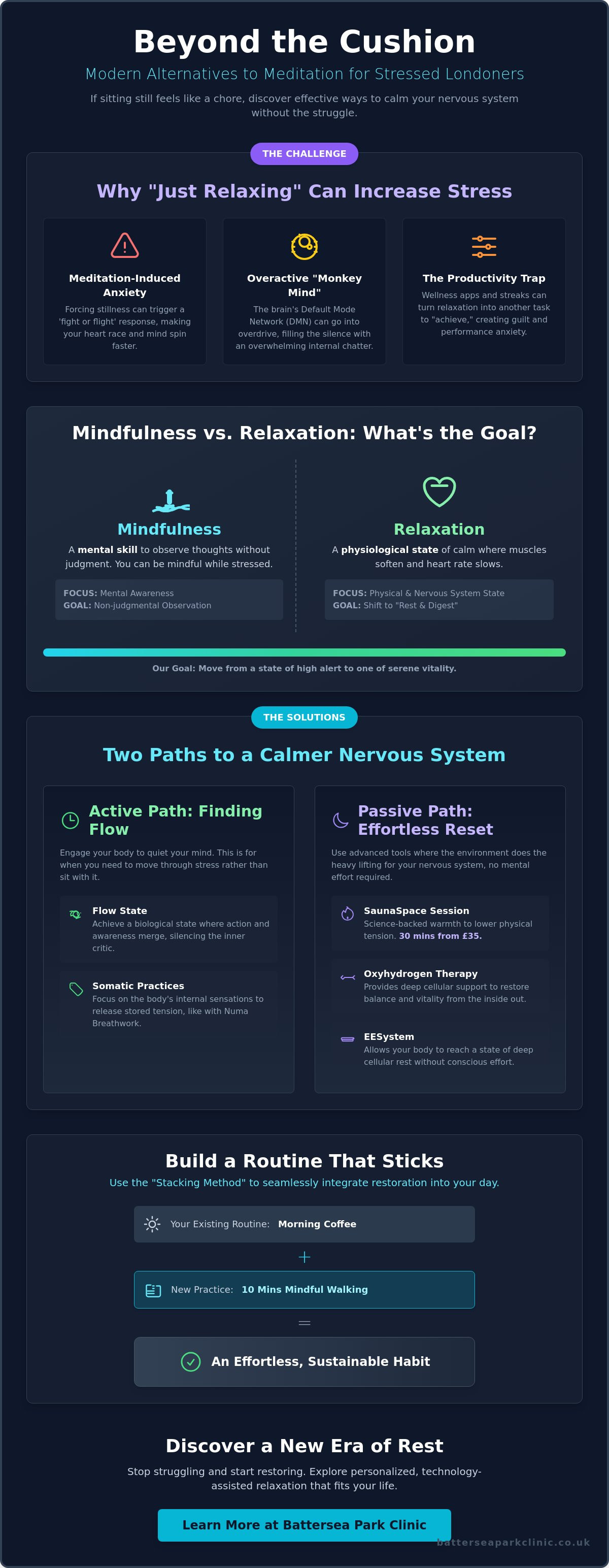
For many, the instruction to "just sit and be" feels less like a sanctuary and more like a high-pressure exam. If silence makes your heart race or your mind spin faster, you aren't failing. You might be experiencing meditation-induced anxiety. This occurs when the sudden removal of external stimuli triggers a fight or flight response rather than peace. Instead of forcing a practice that feels wrong, it's more effective to find a personalized alternative to meditation for relaxation that speaks to your body's current needs. We want to shift the perspective from failing at a specific technique to discovering your unique relaxation language.
We often confuse mindfulness with relaxation, but they serve different purposes. Mindfulness is a mental skill used to observe thoughts without judgment. Relaxation, however, is a physiological state where your heart rate slows and muscles soften. You can be mindful while stressed, but you can't be truly relaxed while your body is stuck in a sympathetic "fight or flight" state. Shifting your nervous system into a state of rest is the primary goal of any successful wellbeing routine. It's about moving from a state of high alert to one of serene confidence and vitality.
The Science of the Restless Mind
When you try to sit still, your Default Mode Network (DMN) often kicks into high gear. This is the brain's internal chatterbox responsible for self-referential thought. For some, this network is so active that silence feels overwhelming rather than restorative. Research suggests that relaxation-induced anxiety affects a significant portion of the population during traditional meditation attempts. When you "try" too hard to relax, your body releases cortisol, the stress hormone, because it perceives the struggle as a task to be conquered. The parasympathetic nervous system is the body's "rest and digest" command centre. Activating it shouldn't feel like a battle; it should feel like a gentle homecoming.
When Traditional Mindfulness Becomes a Chore
Modern wellness has occasionally fallen into a productivity trap. Apps that track "streaks" or set rigid goals can turn a healing journey into another source of daily guilt. The pressure to "clear your mind" often has the opposite effect, creating a mental loop of frustration that builds more tension than it releases. We advocate for a philosophy of accessible wellbeing. This means choosing the path of least resistance to find a calmer, more supported state.
Choosing an alternative to meditation for relaxation allows you to bypass the mental friction of trying to be still. You can explore a comprehensive overview of relaxation techniques that prove there are many ways to reach a state of vitality without ever touching a meditation cushion. Whether through movement or technology, the goal is to find a routine that feels effortless and fits naturally into your lifestyle. When the environment or the activity does the work for you, your mind finally has the permission it needs to let go.
Active Alternatives: Finding Flow Through Movement and Creativity
Stillness is often presented as the only way to achieve peace, but for many, the most effective alternative to meditation for relaxation is actually found in motion. When we engage in focused activity, we can enter a "Flow State." This is a biological phenomenon where the analytical part of the brain takes a backseat, allowing your actions and awareness to merge. In this state, the passage of time seems to vanish, and the internal critic finally goes quiet. It's a powerful way to reset the nervous system without the pressure of forced silence.
Somatic practices focus on the body's internal sensations to release stored tension. Instead of trying to think your way out of stress, you move your way through it. This approach is particularly helpful for those who feel "stuck" in their heads. By shifting your attention to physical rhythm, you can trigger the body's 'relaxation response' more quickly than through sitting alone. It's about giving your mind a job to do so your body can finally rest.
Movement as a Gateway to Stillness
Walking is one of the simplest forms of bilateral stimulation. The rhythmic left-right movement of your legs helps the brain process information and reduces emotional intensity. For a deeper release, many find that Numa breathwork serves as a vital tool for somatic healing, helping to clear physical blockages that traditional quietude might miss. Similarly, practices like Tai Chi or Yoga are often described as "meditation in motion" because they require a gentle, focused coordination that naturally anchors you in the present moment.
Creative Expression and the 'Flow' State
Engaging in a creative hobby isn't just a pastime; it's a way to bypass the analytical brain. Activities that involve your hands, such as pottery, drawing, or gardening, encourage the production of alpha brain waves. These waves are associated with a state of "relaxed alertness," which is the sweet spot for mental recovery. For high-achievers, "doing" something productive but low-stakes can be the most effective way of "being." It replaces the background noise of a busy mind with the tactile satisfaction of creation.
Nature also offers a profound alternative to meditation for relaxation through "Forest Bathing" or grounding. Simply spending 20 minutes in a green space has been shown to significantly lower cortisol levels. If you're looking for a guided way to release this tension, exploring a personalized wellbeing experience at our clinic can help you find your rhythm. Whether through movement or creative play, the goal is to find a path to vitality that feels like a joy rather than a task.
The Passive Path: Using Technology to Shortcut Relaxation
If the thought of active mindfulness feels like another item on your to-do list, it's time to explore the passive path. Environmental relaxation is a modern approach where you let the surrounding technology do the work for your nervous system. This is a powerful alternative to meditation for relaxation because it requires zero mental effort. Instead of trying to quiet your mind, you enter a space designed to guide your body into a state of profound rest automatically. It's about creating a safe, nurturing environment where your biology can finally let go of the day's tension.
For many Londoners, the "monkey mind" is simply too loud to quiet through willpower alone. Passive therapies bypass the need for discipline by directly influencing your physiological state. When you step into a room designed for healing, your body recognizes the shift in frequency and begins to down-regulate. This isn't about "trying" to be still; it's about being supported by cutting-edge tools that promote vitality and balance from the inside out. You can achieve deep cellular rest while simply sitting in a comfortable chair.
EESystem: Relaxation at a Cellular Level
The Energy Enhancement System (EESystem) represents a new era of wellbeing. In a 24-unit EESystem centre, you're immersed in a field of scalar waves and bio-photons. These frequencies support mind-body awareness at a cellular level, helping to recharge your body's energy while you rest. You don't need to focus on your breath or visualize a peaceful scene to feel the benefits. The environment provides the support your cells need to return to a state of serene confidence. For those who want to understand the science behind this technology, our complete guide to EESystem offers a deeper look into how it helps you find a calmer, more supported state.
Oxygen and Light: The Bio-Hacker's Meditation
Another way to shortcut the stress response is through light and oxygen. Hyperbaric Oxygen Therapy (HBOT) involves breathing pure oxygen in a pressurized environment, which saturates your tissues and shifts the body out of "survival mode." It's a deeply calming experience that physically encourages the nervous system to settle. Similarly, infrared light therapy uses specific wavelengths to influence cellular energy and promote systemic relaxation.
While Harvard Health identifies six relaxation techniques that typically involve mental focus, these passive therapies offer a different route for the busy mind. By using environmental support, you can achieve the physiological benefits of rest without the mental hurdle of trying to be still. Whether you're enjoying the soothing warmth of an infrared sauna or the cellular support of a 24-unit energy field, these tools provide a vital alternative to meditation for relaxation that fits seamlessly into a modern lifestyle. It's accessible, affordable, and achievable for anyone seeking a renewed sense of energy.
How to Build a Relaxation Routine That Actually Sticks
Building a routine shouldn't feel like another job on your list. For many, the hardest part of finding an alternative to meditation for relaxation is making it a habit that lasts. It isn't about finding more time; it's about choosing the right activity for your unique "Stress Profile." Some days you might need to move to burn off excess cortisol. On other days, your body might crave the passive support of a technology-led session. True balance is found when you listen to what your nervous system is actually asking for in the moment.
The "Stacking Method" is a simple way to ensure these moments of rest happen naturally. You attach a new relaxation habit to something you already do every day. If you always have a cup of tea at 4 PM, use those ten minutes to step into a green space or practice rhythmic breathing. Frequency is far more important than duration. A ten-minute daily reset is often more effective than a two-hour session once a month. It keeps your body in a calmer, more supported state throughout the week and prevents the build-up of chronic tension.
Identifying Your Relaxation Language
Discovering your relaxation language starts with a simple self-assessment. Are you a "Doer" who finds peace through tactile tasks like gardening, or a "Feeler" who benefits from the environmental support of Hyperbaric Oxygen Therapy? High-achievers often find that active "doing" is their best path to stillness. However, your needs will change depending on the season or your current workload. In the winter, you might prefer the warmth of an infrared sauna, while spring calls for forest bathing. Flexibility is key to a sustainable wellbeing routine.
Creating a 'Personal Wellbeing Ritual'
A personal wellbeing ritual is more than just a list of tasks. It's a commitment to your own vitality and self-care. You might choose to integrate IV drips once a month to restore cellular balance or schedule a weekly technology-free evening. Creating a digital-free sanctuary in your home allows your mind to unplug from the constant stream of information. We believe that true health is accessible, affordable, and achievable for everyone. To start building your own tailored routine, you can begin your healing journey with our supportive team today.
By balancing active methods like movement with passive methods like light therapy, you create a "whole-person" approach to rest. This variety ensures that you always have a tool available, no matter how busy your mind feels. When relaxation feels effortless, it stops being a chore and becomes a natural part of your life. You deserve a routine that returns your energy and leaves you feeling renewed.
Discover a New Era of Rest at Battersea Park Clinic
Finding a true sanctuary in the heart of London can feel like a challenge. At Battersea Park Clinic, we've created a calm oasis specifically designed for those who find the city's pace overwhelming. Our approach is science-informed, gentle, and entirely holistic. We believe that relaxation shouldn't be a struggle. If you've spent years trying to quiet your mind without success, we offer a modern alternative to meditation for relaxation that works with your biology rather than against it. We're here to guide you toward a state of serene confidence and renewed vitality.
Our centre is home to a 24-unit Energy Enhancement System (EESystem), which provides a unique environment for deep rest. This technology creates a field of scalar waves and bio-photons that support your body at a cellular level. You don't need to master any complex techniques or sit in uncomfortable positions. You simply relax in a comfortable chair and let the environment do the work. It's the perfect solution for anyone who struggles with traditional meditation but still craves the profound benefits of a quiet mind and a rested body.
A Sanctuary for the Modern Londoner
Located on Battersea Park Road, our clinic is a world away from the noise of the streets outside. The atmosphere is intentionally serene and supportive, providing a nurturing space for your healing journey. We focus on passive therapies because they're the perfect antidote to a busy city lifestyle. By combining the EESystem with tools like Hyperbaric Oxygen Therapy and Infrared saunas, we offer a multi-therapy approach that addresses the whole person. This synergy helps shift your nervous system into a state of balance more effectively than any single practice could do alone.
Your Invitation to Vitality
Beginning your journey with us is straightforward and supportive. During your first visit, we'll discuss your personal wellbeing goals and help you identify the best path forward. A 1-hour consultation is available for £50, and this fee is redeemable against any future clinic purchase over £100. We're committed to helping you find health and vitality through non-invasive, holistic solutions. You won't find medical treatments or Western medicine here; instead, you'll find a personalised wellbeing routine that respects your body's natural wisdom.
Every session at our clinic is an opportunity to reconnect with yourself and recharge your internal batteries. Whether you're seeking to reduce physical tension or simply want to escape the mental chatter of the day, we provide the tools to make it happen. We've seen how transformative it is when someone finally finds an alternative to meditation for relaxation that feels effortless. Ready to find a relaxation method that actually works for you? Book a session today and take the first step toward a calmer, more supported state of being.
Step Into a Calmer State of Being
True rest doesn't require you to master the art of silence or battle with a restless mind. You've discovered that finding a valid alternative to meditation for relaxation is simply about matching your unique stress profile with the right tools. Whether you choose the rhythmic flow of movement or the passive support of environmental therapy, you're taking a vital step toward restoring your body's natural balance. It's time to let go of the pressure to "perform" relaxation and instead embrace a routine that feels like a natural extension of your self-care.
At Battersea Park Clinic, we offer London's premier 24-unit EESystem centre, providing a sanctuary where your biology can reset without effort. Our holistic, non-medical approach focuses on whole-person wellbeing, ensuring your journey is as gentle as it is effective. We're committed to making deep rest accessible, affordable, and achievable for everyone seeking renewed vitality. You deserve a space where you can finally unplug and feel completely supported.
Ready to experience a deeper level of rest? Begin Your Healing Journey: Book an EESystem Session today and discover how effortless peace can truly be.
Frequently Asked Questions
Is it normal to find meditation stressful?
It's entirely normal to feel stressed during meditation. Research suggests that approximately 25% of people experience meditation-induced anxiety when trying to sit in quiet contemplation. This often happens because the brain's Default Mode Network becomes overactive, triggering a fight or flight response instead of calm. If silence feels like a chore, exploring an alternative to meditation for relaxation is a supportive way to find peace without the mental struggle.
What is the most effective alternative to meditation for anxiety?
Passive therapies that do the work for your nervous system are often the most effective choice for high anxiety. Tools like the EESystem or infrared saunas allow your body to enter a parasympathetic state without requiring intense mental focus. For those who prefer being active, rhythmic movement like walking or gardening helps process excess cortisol. These methods return your body to a state of vitality by bypassing the need for forced stillness.
Can technology really help me relax as well as meditation does?
Technology can be just as effective as meditation because it directly influences your physiological state. While meditation requires active mental effort to lower your heart rate, tools like the Energy Enhancement System use scalar waves to promote rest at a cellular level. This provides a science-informed shortcut to the same "relaxation response" that traditional practices aim for. It's a modern, accessible way to support your personal wellbeing routine in a busy city.
How long does it take to feel the benefits of an EESystem session?
Many individuals report feeling a sense of renewed energy and calm immediately after their first session. However, the benefits of the EESystem are often cumulative. We suggest experiencing a few sessions to allow your body to fully integrate the support. In our 24-unit London centre, sessions are experienced as part of a broader wellbeing routine, helping you maintain a calmer, more supported state over the long term.
Is Hyperbaric Oxygen Therapy safe for everyone?
Hyperbaric Oxygen Therapy is a gentle and safe experience for the vast majority of people. It involves breathing pure oxygen in a pressurized environment to saturate your tissues and promote systemic healing. Certain conditions, such as recent ear surgery or specific lung issues, may require caution. We always recommend a 1-hour consultation to ensure every personalised wellbeing experience is safe and perfectly suited to your specific health profile.
What if I can't sit still for a 2-hour EESystem session?
You don't need to practice "stillness" during your session to see results. Our EESystem environment is designed for comfort, and many clients choose to nap, listen to soft music, or simply rest their eyes. Because the technology works through environmental frequency, your mind doesn't have to be quiet for your body to receive cellular rest. This makes it an ideal alternative to meditation for relaxation for those with a restless mind.
How often should I use these alternatives to see results?
Consistency is the key to seeing lasting results in your vitality and balance. We recommend small, daily 10-minute resets combined with a more immersive weekly or monthly session at our clinic. This frequency helps prevent the accumulation of chronic stress. By integrating these practices into your self-care routine, you ensure that relaxation becomes an achievable part of your lifestyle rather than a rare luxury you never have time for.
Do I need any special preparation for a session at Battersea Park Clinic?
No complex preparation is required for your visit to our sanctuary. We suggest wearing comfortable, loose-fitting clothing and staying well-hydrated before and after your session to support your body's natural processes. When you arrive at our Battersea Park Road clinic, our team will guide you through everything you need to know. Our goal is to make your healing journey as seamless, supportive, and reassuring as possible from the moment you walk in.


Comments