How Often Should You Do Red Light Therapy? A Guide to Optimal Frequency
- alastair208
- 11 minutes ago
- 12 min read
Your body's cellular battery isn't designed to withstand the relentless pace of London life without a regular, intentional recharge. Between the high-pressure demands of the city and the physical toll of a dedicated fitness routine, it's common to feel your internal light fading into chronic fatigue or persistent stiffness. You've likely heard that light is the answer, but the conflicting advice about devices and timing can feel like another source of burnout. You're likely asking how often should you do red light therapy to see real results without overcomplicating your already busy week.
We agree that finding the right rhythm for your wellness shouldn't be another chore on your to-do list. You deserve a clear, actionable path to restoration that fits seamlessly into your lifestyle. This guide provides a tailored schedule to enhance your skin radiance, reduce stiffness, and boost your cellular energy. We'll also explore how light therapy works in harmony with other advanced tools like the Energy Enhancement System (EESystem) to help you maintain a state of serene confidence and vitality.
Table of Contents
How Often Should You Do Red Light Therapy for Real Results?
Living in London often means being submerged in artificial blue light from office screens and the constant hum of the Tube. This environment drains your "light force," the essential biological energy your cells need to function at their peak. Red light therapy acts as a restorative ritual to replenish this vitality. However, many people feel overwhelmed by technical jargon and wonder exactly how often should you do red light therapy to counteract the city's draining effects. It is a common question for those seeking to escape the cycle of chronic fatigue and urban burnout.
It's helpful to view light therapy as a cumulative process rather than a one-off event. While a single session can provide a subtle sense of calm and a minor boost in circulation, the real transformation happens over time. Think of it as building a reservoir of energy within your cells. Each visit to a sanctuary like Battersea Park Clinic adds another layer of resilience to your system. This isn't about a quick fix; it's about a principled commitment to your long-term equilibrium and cellular health.
The Science of the Dose-Response Curve
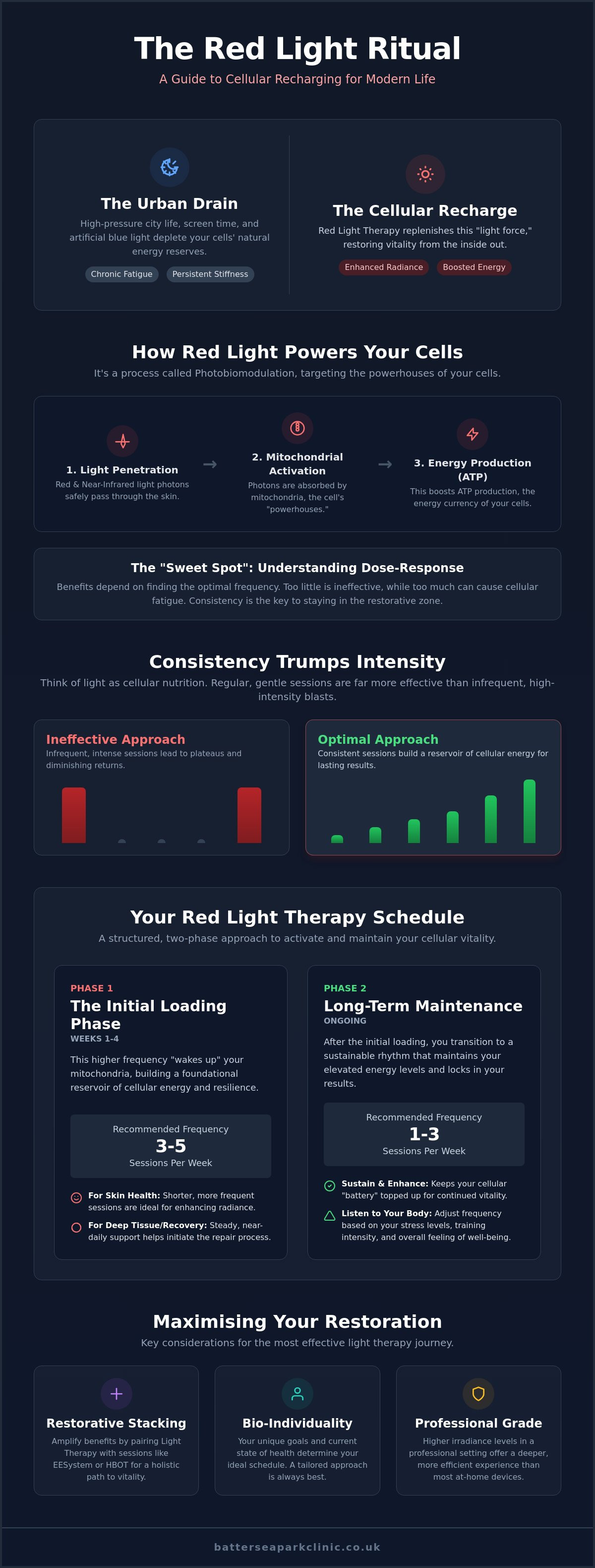
At its core, this process is scientifically known as Low-level laser therapy (LLLT) or photobiomodulation. When red and near-infrared light photons penetrate your skin, they interact with your mitochondria, which are the powerhouses of your cells. There is a specific "sweet spot" in this interaction. If the dose is too low, the cells don't receive enough stimulus to trigger restoration. If the dose is too high, you might encounter the biphasic dose response. This means over-exposure can lead to cellular fatigue, causing the benefits to plateau or diminish. Understanding how often should you do red light therapy helps you stay within that optimal restorative zone.
Why Consistency Trumps Intensity
You wouldn't expect to achieve peak physical health by eating one massive salad or doing a single twelve-hour workout. Light is a form of cellular nutrition. Your body thrives on regular, gentle "feedings" of light rather than infrequent, intense blasts. Between your sessions, your body works to maintain the boost in Adenosine Triphosphate (ATP) production, which is the currency of your cellular energy. This steady supply of energy is what allows for faster recovery from exercise and improved skin texture.
Consistency also supports your body's natural internal clock. Regular exposure to these specific wavelengths helps align your biological systems with natural circadian rhythms, which are often disrupted by the late nights and high-pressure demands of a modern lifestyle. By establishing a steady rhythm, you provide your body with the stability it needs to repair tissue and restore your natural radiance.
Designing Your Red Light Ritual: Loading Phases and Maintenance
Establishing a new wellness practice is an act of self-care that requires both intention and a structured approach. When you begin your journey with light, it's helpful to view it as a two-stage process. The way you approach your sessions in the first month will differ from how you maintain your vitality later on. Determining how often should you do red light therapy depends largely on your current state of vitality and your specific wellness goals. Whether you're seeking to soothe stiff joints after a long commute or looking to restore a youthful glow to your skin, a phased approach ensures your cells aren't overwhelmed.
The Initial Loading Phase (Weeks 1-4)
For those new to this restorative ritual, we typically recommend a "loading phase" of three to five sessions per week. This higher frequency is designed to "wake up" your mitochondria and build a foundation of cellular resilience. During these first four weeks, your body is learning to process the increased influx of photons. It's a period of deep activation where you might notice subtle shifts, such as waking up feeling more refreshed or seeing a gentle lift in your skin's radiance. Creating a consistent rhythm at a dedicated wellness sanctuary in London ensures you stay on track during this vital first month.
Your specific goals also play a role in this phase. If you're focusing on surface-level skin health, shorter and more frequent sessions are often ideal. However, for deep tissue recovery or chronic fatigue, your body may require the steady, daily support of red light to initiate the repair process. This initial commitment is what allows your "light force" to reach a stable, elevated level.
Long-Term Maintenance for Vitality
Once you've achieved your initial goals, you can transition into a maintenance phase. This usually involves two to three sessions per week. This frequency is enough to sustain your cellular energy and act as a preventative shield against the stressors of a high-pressure lifestyle. It's about staying in equilibrium rather than constantly playing catch-up with your health. Many people find it beneficial to increase their frequency during the grey London winter months or during periods of intense work stress to keep their spirits and energy high.
Rest days are a principled part of any ritual. We recommend at least one or two days of rest between intense sessions to allow for cellular integration. Your cells need a moment to breathe. This integration period is just as important as the light exposure itself, as it's when the body completes the restorative cycles triggered by the therapy. Listen to your body's signals; it's the best guide for finding your perfect personal rhythm.
Factors That Determine Your Ideal Light Therapy Schedule
Finding your rhythm with light is a personal journey. While general guidelines offer a helpful starting point, your unique biological makeup and the environment you live in will ultimately define your path. Deciding how often should you do red light therapy isn't just about picking a number of days; it's about understanding the interplay between the light's power and your body's capacity to receive it. Your lifestyle, including your diet and sleep quality, acts as the foundation upon which these sessions build.
Distance and duration also play a quiet but crucial role in the "dose" you receive. Standing closer to a light source increases the intensity of the photons hitting your skin, which may shorten the time needed for a session. Conversely, standing further away allows for a gentler, more diffuse exposure. Balancing these factors requires a mindful approach, ensuring you receive enough energy to trigger restoration without overwhelming your system's natural ability to integrate the light.
Professional-Grade Irradiance vs. Home Devices
The quality of the light source is perhaps the most significant factor in your schedule. Many at-home devices, such as small LED masks or wands, have relatively low irradiance levels. Irradiance refers to the power density of the light reaching your skin. Because these home tools are less powerful, they often require daily use for extended periods to achieve even modest shifts in skin health. This can lead to a sense of burnout if the results don't match the time investment.
In contrast, a professional wellness sanctuary uses high-output, clinic-grade panels. These systems provide a much higher concentration of photons across larger areas of the body. Because the irradiance is so much greater, you'll often find that two or three professional sessions provide more profound results than a week of using a low-powered home device. Full-body exposure in a clinic setting also ensures that your entire system is bathed in restorative wavelengths. This holistic approach supports your "light force" more efficiently than targeting a single small area at a time.
Listening to Your Body’s Bio-Feedback
Every body responds differently to light. Your current stress levels and urban environment can influence how much light your cells can process at once. We encourage a supportive approach to your ritual. When you've found the perfect balance, you'll likely notice signs of deep restoration. This might manifest as a natural "glow" in your complexion, a more restful night's sleep, or a gentle lift in your overall mood. These are the markers of a system returning to equilibrium.
However, it's also possible to overstimulate the system. If you find yourself feeling unusually "wired" or restless after a session, or if you notice temporary skin redness, it may be a signal that your body needs more time to integrate the energy. This is why understanding how often should you do red light therapy is a process of listening to these subtle cues. Keeping a simple wellness journal can be a grounding way to track your progress. Note how you feel in the hours and days following a session to help you fine-tune your schedule for long-term vitality.
Maximising Your Sessions: Synergy with HBOT and EESystem
True vitality often comes from a layered approach to wellness. While red light therapy is powerful on its own, it becomes even more transformative when combined with other supportive technologies. We call this "restorative stacking." By layering gentle, non-invasive therapies, you create a synergistic environment where your body can repair and recharge more effectively. When considering how often should you do red light therapy, it's worth thinking about how it fits into your wider self-care routine. Your internal state also matters; staying well-hydrated and maintaining a healthy mineral balance helps your cells absorb and use the light photons more efficiently.
This stacking method is particularly effective for those dealing with the slow recovery or chronic fatigue that often accompanies a high-pressure lifestyle. Because these therapies are gentle and non-medical, they can be combined safely to support your body's natural healing processes. This isn't about forcing a result. It's about providing your system with the light, oxygen, and energetic environment it needs to find its own way back to equilibrium.
The Red Light and EESystem Connection
The connection between light and the scalar wave therapy UK community is growing. Red light therapy focuses on the physical tissue, stimulating the mitochondria to produce energy. In contrast, the Energy Enhancement System supports the body’s bio-field and internal equilibrium. There is a cumulative effect when you combine light photons with bio-photonic energy. We often recommend scheduling a red light session immediately before entering the EESystem. This sequence helps prime your cells, making them more receptive to the deeper energy work that follows. It's a modern way to enhance your "light force" from both a physical and energetic perspective.
Oxygen and Light: Red Light and HBOT
Oxygen is the fuel that your mitochondria use to convert light into cellular energy. Pairing red light with hyperbaric oxygen therapy creates a powerful partnership for restoration. While the light triggers the production of ATP, the increased oxygen levels provided by HBOT ensure your cells have the necessary resources to complete the process. This holistic approach recharges your internal batteries in a way that feels both deep and lasting. It’s a principled method for overcoming the slow recovery times and fatigue often associated with an urban environment. Determining how often should you do red light therapy alongside HBOT can be discussed as part of your personal wellness journey at our holistic centre in London.
Your Sanctuary for Restoration: Red Light Therapy in London
London's relentless pace often demands more from our bodies than we have to give. Between the crowded commutes and the high-pressure environment of the city, finding a moment of true stillness can feel like a luxury. Battersea Park Clinic was established to be the antidote to this urban chaos. We provide a nurturing environment where you can step away from the noise and reconnect with your internal equilibrium. It's a space designed for those who recognise that wellness is a continuous journey of maintenance rather than a final destination to be reached.
Choosing a professional setting for your light therapy offers an experience that at-home devices simply cannot replicate. It's about more than just the technical irradiance of the panels; it's about the intentional atmosphere of a dedicated sanctuary. Here, your path to restoration is supported by a team that understands the delicate balance between modern technology and holistic care. We help you navigate the practicalities of your ritual, including the common question of how often should you do red light therapy to sustain your personal vitality.
Finding Calm at Battersea Park Road
Stepping off the busy streets and into our clinic on Battersea Park Road immediately signals to your nervous system that it's time to rest. Our centre is designed to be a calm oasis, featuring soft lighting and a serene atmosphere that encourages immediate relaxation. We believe a "digital detox" is an essential part of the process. By leaving the blue light of your phone behind, you allow your system to fully immerse itself in the restorative wavelengths of our professional-grade panels. This quietude is why our clinic is a preferred choice for Londoners seeking a profound sense of peace alongside their physical recovery.
Crafting Your Personal Wellness Ritual
Creating a personal wellness plan is a collaborative process at our clinic. When you arrive for your first session, we guide you through the experience, ensuring you feel safe and comfortable. At the heart of our rejuvenation approach is our 24-unit Energy Enhancement System (EESystem). This advanced technology works in harmony with red light to support your bio-field while the light photons nourish your physical tissue.
Our supportive team is here to help you fine-tune your schedule. We look at your lifestyle, stress levels, and recovery goals to determine how often should you do red light therapy for the most consistent results. Whether you are recovering from intense exercise or seeking relief from the weight of city burnout, we provide a principled framework for your restoration. We invite you to visit us in Battersea to begin your restorative journey and discover a new level of serene confidence in your health.
Embracing Your Personal Path to Vitality
Integrating red light therapy into your lifestyle is a principled act of self-care that builds lasting resilience. By moving through a dedicated loading phase and into a sustainable maintenance rhythm, you provide your cells with the steady nourishment they need to thrive. Finding the right balance for how often should you do red light therapy is a personal journey; it's a process that respects your body's unique bio-feedback and the specific demands of your London lifestyle.
At Battersea Park Clinic, we offer a safe and nurturing environment to help you achieve this equilibrium. As London’s leading 24-unit EESystem centre, we provide expertly guided holistic wellness rituals in a calm, non-medical sanctuary. We invite you to step away from the urban noise and experience the synergistic power of light and scalar energy for yourself. Our team is committed to empowering you on your journey toward restoration and internal connection.
Begin your journey to cellular radiance: Book a session at Battersea Park Clinic
Your path to restoration is waiting. We're here to guide you toward a more vibrant and balanced life with serene confidence and compassionate care.
Frequently Asked Questions
How long does it take to see results from red light treatment?
Visible shifts in your vitality and skin health depend on your specific goals. While many people report a gentle lift in their mood after just one session, physical changes like improved skin texture or reduced joint stiffness typically emerge after four to eight weeks of consistent use. This timeline aligns with the body's natural cellular turnover and collagen production cycles.
Can I do red light therapy every day?
Daily sessions are safe for most individuals, particularly during an initial loading phase. However, we often recommend a rhythm of three to five times per week to allow for dedicated rest days. When considering how often should you do red light therapy, it's important to give your cells time to integrate the energy and complete the restorative processes triggered by the light.
Do I need to wear goggles during my session?
Eye protection is generally recommended, especially when using high-output professional panels at close range. While the wavelengths themselves are gentle, the intensity of the brightness can be overstimulating for the eyes. We provide comfortable goggles at our sanctuary to ensure your session remains a peaceful and relaxing experience for your entire system.
Is red light therapy the same as a tanning bed?
Red light therapy is entirely different from a tanning bed because it contains no harmful ultraviolet (UV) rays. Tanning beds use UV light to trigger melanin production, which can lead to skin damage and aging. In contrast, red light uses restorative wavelengths that support cellular energy and skin radiance without any risk of burning or DNA damage.
Should I do red light therapy before or after my workout?
Both timings offer unique benefits for your physical ritual. Using red light before a workout can help prime your muscles and improve circulation. Many Londoners prefer post-workout sessions to soothe stiffness and accelerate recovery after a demanding session. You can choose the timing that best supports your body's personal rhythm and recovery needs.
Does red light therapy work through clothes?
Direct skin contact is essential for the light photons to be absorbed effectively by your tissue. While very thin, light-coloured fabrics might allow some light to pass through, heavy materials like denim or wool will block the restorative wavelengths entirely. We recommend exposing the area you wish to target to ensure your mitochondria receive the full benefit of the session.
Are there any side effects to red light sessions?
Side effects are rare and typically very mild because the process is non-invasive and gentle. Some individuals may notice a slight, temporary redness in the treated area or a feeling of being unusually "wired" if their system is particularly sensitive to the energy boost. These sensations are usually a sign of increased circulation and typically fade shortly after the session ends.
Can I combine red light with an IV drip session?
Combining these rituals is an excellent way to support a holistic approach to your wellness. While red light therapy works to enhance cellular energy from the outside, an IV drip provides essential nutrients and hydration from the inside. This synergistic pairing helps you achieve a deeper state of restoration and is a popular choice for those looking to counteract the effects of a high-pressure lifestyle.


Comments